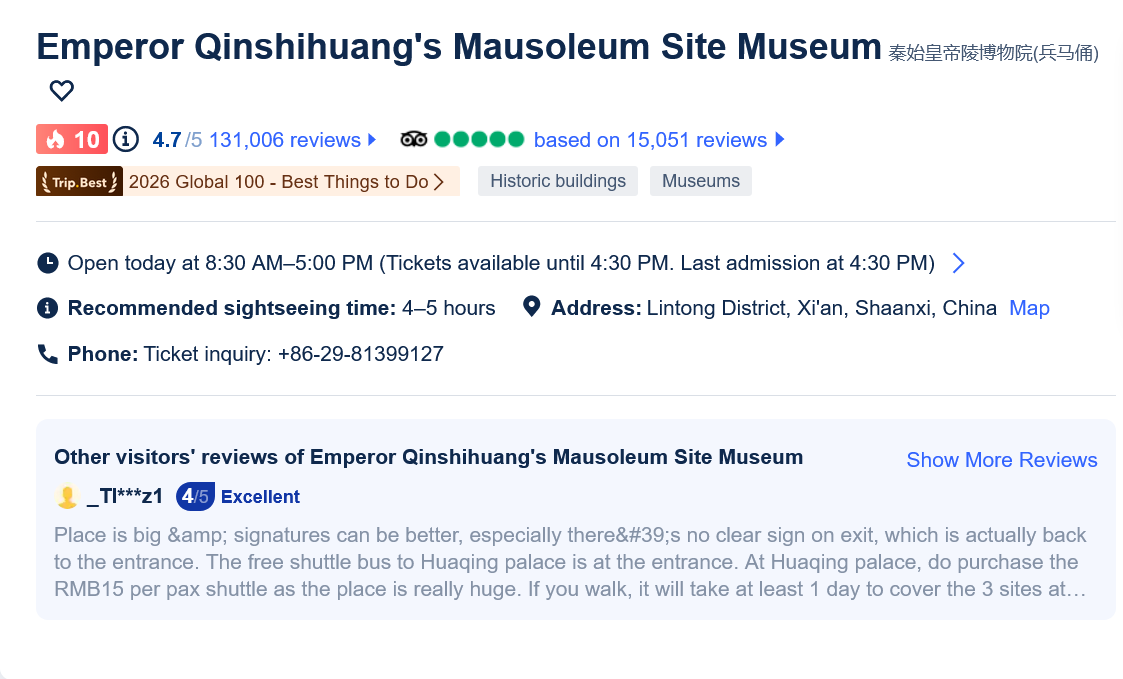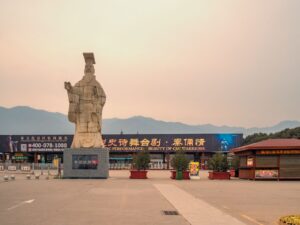
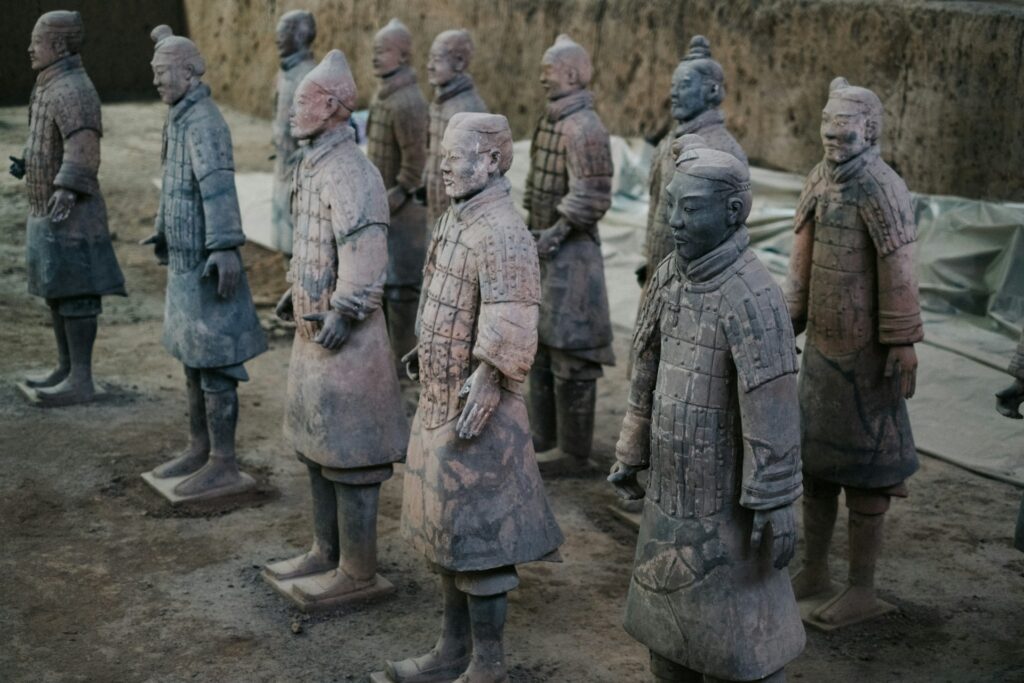

Few archaeological discoveries in human history have captured the global imagination quite like the Terracotta Army. Buried for over two millennia beneath the earth of Shaanxi province, these life-sized clay soldiers stand as a silent testament to the ambition, power, and obsession of China’s First Emperor. For tourists planning a journey to Xi’an, visiting the Musée du site du mausolée de Qin Shi Huang is not merely a sightseeing trip; it is a walk through the corridors of ancient imperial power.
This guide provides a deep dive into the history of Qin Shi Huang, the construction of his necropolis, the accidental discovery of the warriors, and essential practical advice for navigating this UNESCO World Heritage site.
Part 1: The Man Who United China – Qin Shi Huang
To understand the Terracotta Army, one must first understand the man who ordered its creation. Born Ying Zheng in 259 BC, he became the King of the Qin state at the tender age of 13. However, his true legacy began when he embarked on a decade-long campaign of conquest to unify the warring states of China.
The First Emperor
In 221 BC, at the age of 38, Ying Zheng achieved the impossible: he unified China for the first time in history. Discarding the title of “King,” he proclaimed himself Qin Shi Huang, meaning “First Emperor of Qin.” His reign marked the beginning of the Imperial era of China, a system that would last for over 2,000 years.
Radical Reforms
Qin Shi Huang was a ruler of extreme efficiency and ruthlessness. To ensure his unified empire remained stable, he implemented sweeping reforms:
- Standardization: He standardized weights, measures, currency, and the width of cart axles to improve trade and transport.
- Writing System: He unified the Chinese script, allowing communication across diverse regions.
- Infrastructure: He initiated the connection of various defensive walls, creating the early foundation of the Great Wall of China, and built a massive network of imperial roads.
- Legalism: He ruled through a strict philosophy known as Legalism, which emphasized harsh punishments and absolute obedience to the state.
The Obsession with Immortality
Despite his earthly power, Qin Shi Huang was terrified of death. As he aged, he became obsessed with finding the elixir of life. He sent expeditions to distant seas and consumed potions prepared by alchemists, many of which contained mercury. Ironically, these “medicines” likely contributed to his premature death in 210 BC. It was this fear of the afterlife that drove the construction of his massive mausoleum. He believed he would need an army to protect him and rule in the next world just as he did in the mortal one.
Part 2: The Grand Project – Building the Necropolis
The construction of the mausoleum began shortly after Ying Zheng ascended the throne as King of Qin, but it intensified after he became Emperor. It is considered one of the largest burial structures ever created.
Location and Feng Shui
The site is located at the foot of Mount Li, approximately 35 kilometers east of Xi’an. The location was chosen based on ancient geomancy (Feng Shui). Mount Li was rich in jade and gold, and the site was positioned between the Wei River to the north and the mountains to the south, creating a “dragon’s pulse” of energy ideal for an emperor’s eternal rest.
Scale and Labor
Historical records, particularly the Shiji (Records of the Grand Historian) written by Sima Qun, suggest that the project employed over 700,000 conscripted workers. This labor force included soldiers, convicts, and commoners from across the empire. The construction continued for roughly 38 years, only halting when rebellions erupted shortly after the Emperor’s death.
The Underground Palace
While the Terracotta Army pits are the main attraction for tourists today, they are actually just a fraction of the total necropolis. The main tomb mound, where Qin Shi Huang’s body is believed to rest, remains unexcavated. Ancient texts describe this underground palace as containing:
- Replicas of palaces and pavilions.
- Rivers and seas made of flowing mercury.
- A ceiling decorated with pearls and gems to resemble the heavens.
- Crossbows rigged as traps to shoot anyone attempting to breach the tomb.
Part 3: The Accidental Discovery (1974)
For over 2,000 years, the Terracotta Army slept in silence. The location of the tomb mound was known, but the existence of the warrior pits was lost to history.
The Farmers of Xiyang Village
On a hot day in March 1974, a group of local farmers from Xiyang Village was digging a well to irrigate their crops during a drought. As they dug deeper, they encountered fragments of red pottery and bronze arrows. Initially, they feared they had disturbed a temple or a dragon’s lair. However, as they continued, they unearthed the torso of a life-sized clay figure.
News reached local cultural authorities, who recognized the significance immediately. Archaeologists were dispatched, and what they found shocked the world. It was not a single statue, but an entire army buried in battle formation. This discovery is often hailed as the greatest archaeological find of the 20th century.
Part 4: Inside the Pits – The Army Explained
For tourists visiting the Musée du site du mausolée de Qin Shi Huang, the experience centers around three main excavation pits. Each pit serves a different military function, showcasing the sophistication of the Qin military machine.
Pit 1: The Main Army
Pit 1 is the largest and most impressive of the three. It is housed under a massive hangar-like structure.
- Composition: This pit contains the main infantry force. It is estimated to hold over 6,000 warriors and horses, though excavation is ongoing.
- Formation: The soldiers are arranged in a battle formation with vanguard troops at the front, followed by the main body of infantry, and flanked by warriors on the sides to protect the rear.
- Chariots: Several wooden war chariots were found here, pulled by teams of four terracotta horses.
- Visual Impact: Standing at the viewing platform, the sheer scale of the rows of soldiers stretching into the darkness is breathtaking.
Pit 2: The Elite Units
Discovered in 1976, Pit 2 is more complex militarily. It represents the cavalry and archer units.
- Diversity: This pit contains a mix of infantry, cavalry, and chariots. It is famous for its kneeling archers, which are incredibly detailed.
- Preservation: Because Pit 2 was covered more securely than Pit 1, some figures retained more of their original pigment upon discovery, though exposure to air caused rapid oxidation.
- Tactics: The layout demonstrates advanced military tactics, showing how different units would coordinate during an attack.
Pit 3: The Command Center
Pit 3 is the smallest but arguably the most important strategically.
- Function: Archaeologists believe this was the headquarters or command post for the entire underground army.
- Officers: The warriors found here are higher-ranking officers. They wear different armor and headdresses compared to the common soldiers in Pit 1.
- The Unfinished Look: Interestingly, Pit 3 appears to have been left unfinished. Some figures were never placed, and the layout is less organized, leading historians to theorize that the rebellion that followed the Emperor’s death halted construction abruptly.
The Craftsmanship: No Two Faces Alike
One of the most fascinating aspects for visitors is the individuality of the warriors.
- Modular Construction: The bodies were made using molds for efficiency (legs, torsos, arms), but the heads were hand-sculpted.
- Realism: Each face has unique features, expressions, hairstyles, and ear shapes. Some look stern, some calm, some young, and some old. It is believed they may have been modeled after real soldiers in the Qin army.
- Original Colors: When first unearthed, the warriors were brightly painted in pink, red, green, and blue. However, the lacquer layer curled and flaked off within minutes of exposure to dry air. Modern preservation technology is now being used to try and save the color on newly excavated figures.
Weapons and Technology
The warriors were originally equipped with real bronze weapons, including swords, spears, crossbows, and dagger-axes.
- Sharpness: Many of these swords are still incredibly sharp today, over 2,000 years later.
- Chrome Myth: For years, it was rumored that the weapons were chrome-plated to prevent rust. Modern analysis has shown this was not intentional plating but rather a natural oxidation layer combined with high-quality bronze alloying and the preservation properties of the soil.
Part 5: Beyond the Soldiers – Other Treasures
While the warriors steal the show, the museum complex houses other incredible artifacts that provide context to the Qin Dynasty lifestyle.
The Bronze Chariots
Discovered in 1980 near the main tomb mound, two half-size bronze chariots were found. They are considered the pinnacle of bronze casting technology from that era.
- Detail: Each chariot consists of over 3,000 parts. They feature gold and silver inlays, and the horses are adorned with intricate harnesses.
- Function: One chariot was designed for the Emperor to ride in (a luxury carriage), while the other was a protective escort vehicle. They are displayed in a dedicated hall within the museum complex.
The Acrobats and Officials
In other sections of the necropolis (some accessible via special tours or displayed in auxiliary halls), archaeologists have found figures that are not soldiers.
- Civil Officials: Figures wearing robes and caps, representing the bureaucratic administration of the empire.
- Entertainers: Statues of acrobats and strongmen have been found, suggesting the Emperor wanted entertainment in the afterlife as well as protection.
- Bronze Birds: Rare bronze sculptures of water birds have also been unearthed, indicating a desire to recreate the natural world within the tomb.
Part 6: The Mystery of the Unexcavated Tomb
A common question from tourists is: “Why don’t they dig up the Emperor’s tomb?”
The main burial mound, a large pyramidal hill covered in pomegranate trees, remains sealed. There are several reasons for this:
- Preservation Technology: When the Terracotta Warriors were first exposed, the paint peeled off instantly due to a lack of technology to preserve organic materials. Archaeologists do not want to risk damaging the contents of the main tomb until they are certain they can preserve silk, paintings, and other fragile artifacts.
- Mercury Levels: Scientific testing of the soil around the mound has shown extremely high concentrations of mercury. This supports the historical accounts of “rivers of mercury” inside the tomb. Excavating could release toxic fumes.
- Respect: There is a growing philosophical shift in Chinese archaeology to respect the resting place of the ancestors and not disturb the tomb unless necessary for preservation.
Part 7: Tourist Guide – Visiting the Museum
Planning your visit correctly can make the difference between a chaotic experience and a profound journey into history. Here is everything you need to know to visit the Musée du site du mausolée de l'empereur Qinshihuang.
Location and Transportation
- Location: Lintong District, Xi’an, Shaanxi Province, China.
- From Xi’an City Center: The museum is about 40 kilometers (25 miles) east of Xi’an.
- By Bus: The most common method is taking Tourist Bus Line 5 (306) from the Xi’an Railway Station. It is affordable and direct.
- By Taxi/Didi: Ride-hailing apps like Didi are widely available in Xi’an. This offers more comfort but is more expensive.
- By Private Tour: Many hotels and travel agencies offer private car services with English-speaking guides, which is highly recommended for historical context.
Tickets and Entry
- Ticket Structure: The ticket usually covers entry to the Terracotta Army pits (Pits 1, 2, 3), the Bronze Chariots exhibition, and the site of the Emperor’s Tomb mound.
- Pricing: Prices vary by season (Peak season is generally spring and autumn). It is advisable to book tickets online in advance through official WeChat channels or authorized travel platforms, especially during national holidays.
- ID Requirement: Foreign tourists must bring their passports for ticket verification.
Meilleure période pour visiter
- Season: Spring (April-May) and Autumn (September-October) offer the most pleasant weather in Xi’an. Summers can be scorching hot, and winters are cold and dry.
- Time of Day: Arrive as early as possible (right when the museum opens, usually around 8:30 AM). The site gets extremely crowded by mid-morning, particularly with large tour groups.
- Avoid Holidays: Try to avoid Chinese National Holidays (especially the first week of October and Chinese New Year), as domestic tourism spikes dramatically.
How Long to Spend
- Minimum: Allow at least 3 to 4 hours to see the three pits and the bronze chariots properly.
- Ideal: Half a day (5-6 hours) allows for a leisurely pace, time for the museum shop, and a visit to the tomb mound.
Hiring a Guide
While audio guides are available, hiring a licensed human guide is highly recommended. The history is complex, and a good guide can point out details you might miss, such as the difference in armor between officers and soldiers, or the specific restoration work being done in the pits. Ensure your guide is licensed to avoid unofficial touts outside the entrance.
Photography Rules
- Allowed: Photography is generally allowed in the museum halls without flash.
- Restricted: Flash photography is strictly prohibited as it can damage the pigments. Tripods may require special permission. Some specific exhibition areas may ban photography entirely.
Nearby Attractions
Since you are already in the Lintong District, consider visiting:
- Huaqing Palace: A historical hot spring palace famous for the romance between Emperor Xuanzong and Yang Guifei.
- Mount Li: You can take a cable car up the mountain behind the mausoleum for a panoramic view of the area.
Part 8: Frequently Asked Questions (FAQ)
Q: Are the Terracotta Warriors real people? A: No, they are life-sized clay sculptures. However, there is a dark historical theory that some craftsmen may have been entombed with the emperor, but the warriors themselves are statues.
Q: Can I touch the Terracotta Warriors? A: Absolutely not. The figures are fragile, and oils from human skin can damage the surface. Barriers are in place to keep visitors at a safe distance.
Q: How old is the Terracotta Army? A: The army was created between 246 BC and 208 BC, making it over 2,200 years old.
Q : Le musée est-il accessible aux personnes en fauteuil roulant ? A: Yes, the main pits and exhibition halls are equipped with ramps and elevators to accommodate visitors with mobility issues.
Q: Are there restrooms and food available? A: Yes, there are clean restroom facilities within the museum complex. There are also cafeterias and snack shops, though prices are higher than in the city. Many tourists prefer to eat in Xi’an city before or after the trip.
Q: Can I buy replicas? A: Yes, the museum gift shop sells high-quality replicas of the warriors and bronze chariots. You can also find vendors outside, but bargaining is expected there.
Conclusion: A Legacy in Clay
Standing before the ranks of the Terracotta Army, one cannot help but feel a sense of awe. These figures were not created for the living to see; they were meant for the eyes of gods and the spirit of an Emperor. They represent a time when China was forged into a unified nation through iron will and immense organization.
For the modern traveler, the Musée du site du mausolée de Qin Shi Huang offers a tangible connection to the ancient past. It is a place where history, art, and mystery converge. Whether you are a history buff, an art lover, or simply a curious traveler, the silent gaze of these clay soldiers is an experience that lingers long after you leave Xi’an.
As you walk through the halls, remember that you are witnessing only a fraction of what lies beneath. The main tomb remains sealed, guarding its secrets for a future generation that may one day possess the technology to open it without destruction. Until then, the Terracotta Army stands guard, an eternal legacy of the First Emperor’s quest for immortality.
Plan your trip, respect the history, and prepare to be amazed by the Eighth Wonder of the World.