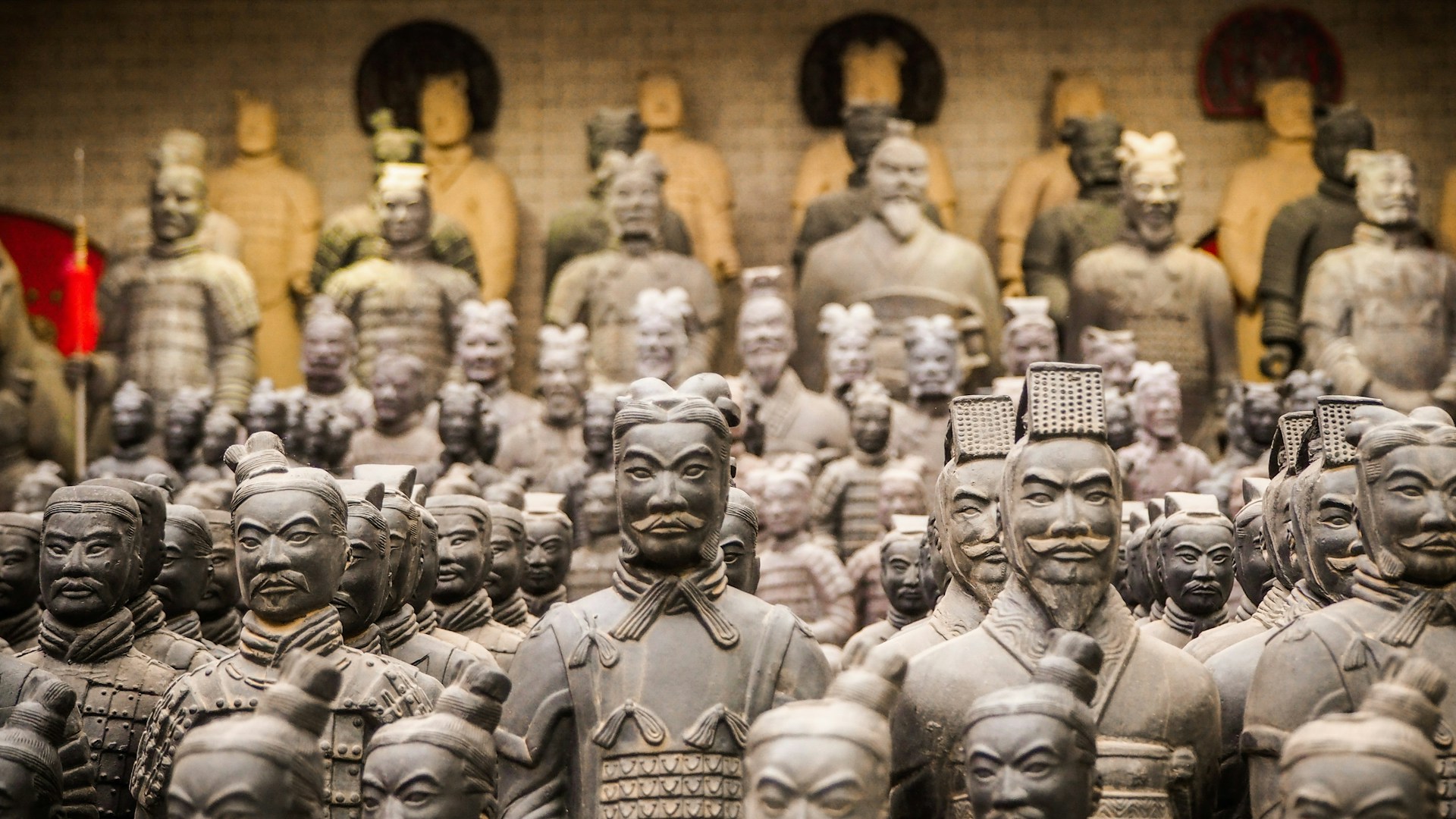
Where 8,000 Silent Soldiers Guard an Emperor’s Eternal Dream
Introduction: The Greatest Archaeological Discovery of the 20th Century
Imagine digging a well in your backyard… and uncovering an army. Not a metaphorical one — but 8,000 life-sized warriors, each with unique facial expressions, armor styles, and weapons, buried for over two millennia beneath the soil of central China.
This is not fantasy. This is the Terracotta Army — the breathtaking funerary guard of Qin Shi Huang, the First Emperor of China. Discovered by accident in 1974, it has since become the #1 reason tourists from every corner of the globe flock to Xi’an, transforming this ancient capital into one of the most visited archaeological sites on Earth.
More than just statues — these are time capsules. Each soldier tells a story: of loyalty, craftsmanship, imperial ambition, and the terrifying grandeur of a ruler who believed he would rule even beyond death.
Welcome to the Eighth Wonder of the World — where history breathes, clay remembers, and silence speaks louder than words.
➤ 3.1 Discovery & Excavation — From Well-Diggers to World Heritage
How Farmers Found It (March 1974)
It began with a simple act: digging a well.
On March 29, 1974, local farmers — Yang Zhifa, Yang Peiyan, Yang Xingfa, and others — were excavating near Lintong District, about 35 kilometers east of Xi’an, when their shovels struck something hard. At first, they thought it was pottery. Then came fragments of a human face. A torso. An arm.
They unearthed what looked like a clay warrior — broken, but unmistakably human-shaped. News spread quickly. Within weeks, archaeologists arrived.
What followed was one of the most dramatic archaeological revelations in modern history.
“We didn’t know we’d found an emperor’s army — we thought maybe some old temple statues.”
— Yang Zhifa, lead farmer who discovered Pit 1
UNESCO World Heritage Site (Since 1987)
In 1987, UNESCO declared the Mausoleum of the First Qin Emperor and the Terracotta Warriors a World Heritage Site, citing its “outstanding universal value” as:
“A masterpiece of human creative genius… reflecting the power and ideology of the first unified Chinese empire.”
Today, it draws over 10 million visitors annually — more than the Louvre or Machu Picchu per capita — making it not just a national treasure, but a global icon.
Ongoing Archaeological Work — Still Unearthing Secrets
Despite decades of excavation, only about 1% of the entire burial complex has been fully explored.
🔹 New Discoveries Every Year: In 2021, archaeologists uncovered over 200 new terracotta figures, including armored cavalrymen and acrobats — suggesting the emperor’s afterlife included entertainment as well as warfare.
🔹 Pit 4 Remains Sealed: Originally planned as a massive ceremonial pit, Pit 4 was never completed — likely due to the emperor’s sudden death and subsequent collapse of the dynasty. It remains untouched, preserved for future technology.
🔹 Mercury Detection: Soil tests continue to confirm high levels of mercury near the inner tomb — supporting ancient texts that describe rivers of liquid metal flowing through the underground palace.
🔹 Digital Mapping: Using LiDAR, drones, and AI-powered imaging, researchers now create 3D reconstructions of unexcavated areas — revealing hidden chambers, tunnels, and possible traps.
This isn’t static history — it’s living archaeology. You’re witnessing discoveries unfold in real time.
➤ 3.2 What You’ll See at the Museum — A Military Machine Frozen in Clay
The site consists of three main pits, plus a separate Bronze Chariots Exhibition Hall, all housed under vast climate-controlled structures designed to preserve the fragile artifacts.
🏹 Pit 1 – The Main Army (6,000+ Warriors)
📍 The heart of the wonder — largest and most impressive.
- Size: 210 meters long x 62 meters wide — roughly the size of 12 football fields
- Soldiers: Over 6,000 infantrymen arranged in precise battle formation — front lines armed with crossbows, rear ranks with spears and halberds
- Details: Each warrior has individualized features — different hairstyles, mustaches, facial expressions, even shoe laces!
- Horses & Chariots: Interspersed among soldiers — bronze reins, wooden wheels (now decayed), and horse harnesses still intact
💡 Pro Tip: Climb the elevated platform at the far end for the best panoramic view — you’ll feel like you’re standing atop a battlefield frozen in time.
🐎 Pit 2 – The Tactical Wing (Cavalry, Archers, Chariots)
📍 The elite forces — showcasing military innovation.
- Units: Mixed formations — archers kneeling and standing, cavalry mounted on horses, chariot units ready for charge
- Strategic Layout: Designed for flanking maneuvers and rapid response — proof that Qin’s military wasn’t just brute force, but sophisticated strategy
- Highlights:
- Kneeling Archers — poised mid-draw, fingers curled around bowstrings
- Cavalry Horses — muscular, alert, with detailed bridles and saddles
- Chariot Drivers — gripping reins, eyes forward, mouths slightly open as if shouting commands
This pit reveals how Qin combined speed, precision, and firepower — centuries before Europe developed similar tactics.
🧭 Pit 3 – The Command Center (Headquarters of the Army)
📍 The brain behind the brawn — small but powerful.
- Size: Only 520 square meters — smallest of the three
- Purpose: Believed to be the general’s headquarters — housing officers, standard-bearers, and ritualists
- Key Figures:
- High-Ranking Officers — taller than regular soldiers, wearing ornate armor and elaborate headdresses
- Standard-Bearer — holding a banner symbolizing command authority
- Ritualist Figures — possibly priests conducting ceremonies before battle
Unlike Pits 1 and 2, which show combat readiness, Pit 3 reflects military hierarchy, leadership, and spiritual preparation — essential elements of Qin’s war machine.
🛡️ Bronze Chariots Exhibit (Pit 4 Not Yet Open)
📍 Masterpieces of metallurgy — miniature marvels of engineering.
Located in a separate hall, these two full-scale bronze chariots were discovered in 1980 — buried near the emperor’s tomb, not with the army.
🔸 Chariot No. 1 (Standing Chariot)
- Used for reconnaissance or inspection
- Driver stands upright, holding reins
- Ornate canopy, intricate gear mechanisms
🔸 Chariot No. 2 (Seated Chariot)
- Ceremonial vehicle for the emperor himself
- Enclosed cabin with windows, roof, and cushions
- Wheels made of solid bronze with rubber-like tires (originally wood + lacquer)
Each chariot weighs over 1 ton, contains 3,000+ components, and was assembled using interlocking joints and soldering techniques so advanced they rival modern craftsmanship.
“These aren’t toys — they’re functional machines forged in bronze, meant to carry the emperor into eternity.”
— Dr. Zhang Wei, Chief Conservator, Terracotta Museum
➤ 3.3 Visitor Tips & Practical Info — Plan Like a Pro
Visiting the Terracotta Army is a once-in-a-lifetime experience — but without planning, it can turn chaotic. Here’s how to make the most of your trip.
⏰ Opening Hours
- Daily: 8:30 AM – 5:30 PM
- Last Entry: 4:30 PM
- Closed: None — open year-round, including holidays
📌 Best Time to Visit: Early morning (8:30–10 AM) or late afternoon (3–4:30 PM) to avoid peak crowds. Midday (11 AM–2 PM) is packed with tour buses.
💰 Ticket Price (As of 2026)
- ¥120 RMB (~$17 USD) — includes access to:
- All three pits (Pit 1, 2, 3)
- Bronze Chariots Exhibition Hall
- Museum entrance and audio guide rental (optional)
✅ Discounts Available: Students, seniors (60+), children under 1.2m — check official website for updated policies.
🚶♂️ Getting There
- From Xi’an City Center: Take tourist bus #5 (¥7) or metro Line 9 to “Huaqingchi Station,” then shuttle bus (¥5). Total travel time: ~1 hour.
- Private Transfer: Recommended for groups — book via hotel concierge or apps like DiDi or Ctrip.
- Self-Drive: Parking available onsite (¥10/day).
🗣️ Guided Tours — Book Ahead!
Don’t wander alone — hire a licensed guide to unlock deeper meaning.
🔹 Official Guided Tours (available onsite or online): ¥150–300 per group (up to 10 people)
🔹 Audio Guides: ¥40 (multilingual options: English, French, Spanish, Japanese, Korean, Russian)
🔹 VIP Private Tours: Includes skip-the-line entry, exclusive access to restricted viewing platforms, and expert commentary — from ¥800+
📅 Book Online: Reserve tickets + guided tours via Klook or Ctrip.
➤ 3.4 Photography Rules — Capture the Magic Without Damaging It
You’re allowed — even encouraged — to photograph the wonders… but with care.
🚫 No Flash Photography
Flash damages pigments and accelerates degradation of painted surfaces. Even though most warriors appear gray today, traces of vibrant colors remain — and flash can destroy them permanently.
🚫 No Drones Allowed
Strictly prohibited inside the museum grounds. Violators risk fines up to ¥5,000 and confiscation of equipment.
📸 Best Angles & Shots:
- Elevated Platform in Pit 1 — captures the scale and symmetry of the army
- Close-Ups of Faces — zoom in on expressions, armor details, weapon grips
- Reflections in Glass Cases — try shooting from low angles to capture both statue and reflection
- Golden Hour Lighting — late afternoon sunlight casts dramatic shadows across the trenches
📱 Tip: Use your phone’s “portrait mode” or manual focus to isolate individual warriors against blurred backgrounds.
Final Thought: Why This Isn’t Just Another Museum
The Terracotta Army isn’t merely a collection of ancient sculptures — it’s a living monument to human ambition, artistry, and fear of mortality.
These warriors weren’t built to impress tourists — they were crafted to protect an emperor who believed he would rise again, conquer death, and rule forever.
That belief — mad, magnificent, and utterly human — is why millions come to see them. Not because they’re old. But because they’re alive.
Their eyes still watch. Their hands still grip weapons. Their silence still echoes.
Come. Look closely. You might just hear them whisper:
“We wait. We serve. We remember.”
Plan Your Trip Today — Before the Next Warrior Is Unearthed
👉 Book Tickets | Klook or Ctrip.
“All empires fall. But legends endure.”
— Inscription near Pit 1 Entrance
Next Stop: Inside the Tomb — What Lies Beneath the Mound?
