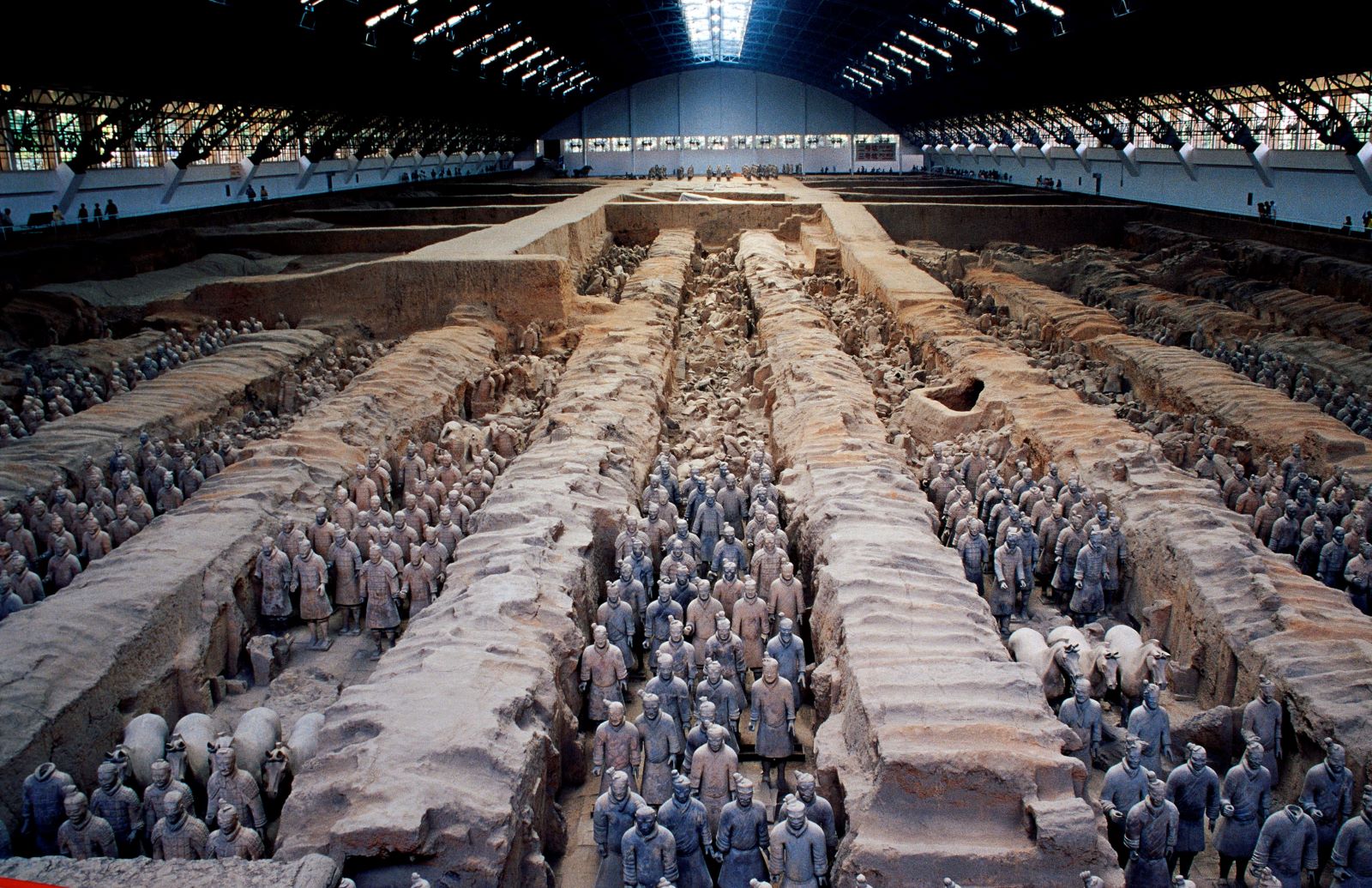
Introduction: A Kingdom Beneath the Earth
Beneath a grassy mound rising like a sleeping dragon in the Lishan foothills of Shaanxi Province lies not just the corpse of China’s first emperor — but an entire subterranean universe. This is the Mausoleum of Qin Shi Huang, the most ambitious funerary complex ever conceived by human hands.
It is not merely a tomb. It is a microcosm of empire, a cosmic map etched in bronze and jade, a fortress of mercury rivers and mechanical guardians, and perhaps — according to ancient whispers — a place where death itself has been defied.
Despite over 50 years since its accidental discovery in 1974, the core burial chamber remains untouched. Why? Because no one dares dig deeper — not out of superstition alone, but because science, culture, and fear have conspired to keep it sealed.
This is the story of the Forbidden Tomb — the last great mystery of antiquity, still breathing beneath our feet.
➤ 4.1 Location & Layout — An Empire Under the Mountain
The Mound That Hides a World
The mausoleum sits at the foot of Lishan Mountain, near modern-day Xi’an — once the capital of the Qin Dynasty, Xianyang. But this isn’t natural terrain. The “mountain” is actually a man-made earthen pyramid, constructed with millions of laborers over decades.
📍 Dimensions:
- Height: ~76 meters (250 ft) — taller than the Pyramid of Menkaure in Giza
- Base: ~350 meters per side — roughly 12 football fields squared
- Total Area: 56 square kilometers — larger than Vatican City, Monaco, or Manhattan’s Central Park
It was designed as a mirror image of the living world — a cosmic replica of Qin Shi Huang’s earthly realm, meant to sustain him for eternity.
Architectural Grandeur Beyond Imagination
Sima Qian’s Records of the Grand Historian (c. 90 BCE) describes the tomb in haunting detail:
“The palace contains palaces, officials, rare utensils, and treasures… the upper part represents the heavens with stars; the lower part represents the earth with rivers and seas filled with mercury.”
Modern geophysical surveys confirm much of what Sima Qian wrote — including:
🔹 Mercury anomalies detected across the central chamber area — matching descriptions of “rivers flowing with liquid metal.”
🔹 Magnetic disturbances suggesting massive underground structures — possibly walls, chambers, or even mechanical devices.
🔹 Subterranean corridors radiating outward like veins from a heart — some extending hundreds of meters beyond known pits.
The layout follows strict cosmological principles:
- North-South Axis: Aligns with celestial poles
- Three-Tiered Structure: Outer courtyard → inner palace → core chamber (where the body rests)
- Symbolic Geography: Mountains represented by mounds, rivers by mercury channels, constellations mapped on ceilings
This wasn’t just burial — it was immortal architecture, built to replicate heaven and earth within stone and soil.
➤ 4.2 Why Hasn’t It Been Excavated? — Science, Superstition, and Sovereignty
Despite global fascination, the main burial chamber remains unopened. Not due to laziness — but caution, reverence, and technological limitation.
🛑 Technological Limitations: We’re Not Ready Yet
Excavating the core would require:
✅ Climate-controlled environments to prevent oxidation of organic materials (silk, wood, lacquer)
✅ Non-invasive imaging tools capable of mapping interiors without digging
✅ Preservation techniques that don’t exist yet — especially for mercury-rich artifacts
In 2002, Chinese archaeologists used ground-penetrating radar and muon tomography (similar to medical CT scans) to peer inside — revealing structures consistent with Sima Qian’s account. But they stopped short of excavation.
“We can see what’s there — but we cannot preserve it if we disturb it.”
— Dr. Duan Qingbo, former director of the Mausoleum Research Institute
China refuses to rush — unlike past Western expeditions that damaged sites like Tutankhamun’s tomb. Here, preservation trumps discovery.
🙏 Cultural Reverence: The Dead Must Rest
In traditional Chinese belief, disturbing ancestral graves invites disaster — both spiritual and political. Emperor Qin Shi Huang is not seen as a mere historical figure — he is a cosmic sovereign, whose resting place holds balance between yin and yang.
Even today, local villagers avoid walking atop the mound after dark. Folk tales speak of ghostly soldiers patrolling the perimeter, and strange lights flickering above the site during lunar eclipses.
Government policy reflects this sensitivity: no excavation without full international consensus and technological readiness.
⚔️ Myth vs Reality: Curses, Traps, and Mechanical Guardians
Legends abound:
- Booby Traps: Arrows rigged to fire automatically upon intrusion — described in Sima Qian as “mechanical crossbows ready to shoot any who enter.”
- Poisonous Gas: Mercury vapor believed to be lethal if disturbed.
- Curses: Stories claim those who desecrate the tomb suffer madness, illness, or death — echoing similar myths around Egyptian pharaohs.
Reality Check:
While mercury poisoning is real (and dangerously high levels have been measured), there’s no evidence of active traps. However, the psychological deterrent works — few scholars dare push for excavation, fearing backlash or bad luck.
Some researchers believe the “traps” were symbolic — meant to deter grave robbers through terror rather than mechanics. Others argue advanced engineering may have included pressure-sensitive triggers — lost to time.
Either way, the myth persists — and serves as a powerful cultural shield protecting the tomb.
➤ 4.3 What We Know From Surveys — Glimpses Into Eternity
Though the main chamber remains sealed, decades of non-invasive exploration have revealed astonishing truths.
🔬 Mercury Rivers Confirmed
In 2002, scientists using neutron activation analysis detected abnormally high concentrations of mercury directly beneath the mound — precisely where Sima Qian said “rivers and seas flow with mercury.”
This suggests either:
- Actual pools of elemental mercury simulating waterways
- Or symbolic representations using mercury-infused pigments or alloys
Either way, it confirms the accuracy of ancient texts — and raises questions about how such toxic material was handled safely.
🏛️ Replicas of Palaces & Officials Inside
Georadar scans show multiple large rectangular chambers surrounding the central vault — likely housing miniature versions of imperial palaces, administrative offices, and ceremonial halls.
These may contain:
- Statues of court ministers, eunuchs, concubines
- Bronze chariots, weapons, musical instruments
- Jade burial suits (worn by nobles to preserve the body)
- Silk scrolls, bamboo manuscripts, ritual objects
One theory posits that the tomb includes life-sized replicas of Qin Shi Huang’s actual court, frozen in eternal service — akin to the Terracotta Army, but far more intimate and luxurious.
💎 Treasures Beyond Imagination
What else might lie hidden?
🔸 Imperial Seal: The legendary jade seal carved with “Received Mandate from Heaven, Eternal Longevity” — last seen during the Han Dynasty
🔸 Bronze Chariots: Two exquisitely crafted bronze chariots discovered in 1980 outside the main tomb — each weighing over 1 ton, adorned with gold and silver
🔸 Jade Armor: Possibly worn by the emperor himself — only fragments found elsewhere suggest its existence
🔸 Astronomical Ceiling: Painted constellations mirroring the night sky at the time of his death
And perhaps — most tantalizingly — his body, preserved in some unknown manner, wrapped in silk, encased in jade, lying atop a bed of pearls and mercury.
➤ 4.4 Viewing Platform & Museum Exhibits — Witnessing the Unseen
You cannot enter the tomb — but you can stand on its edge, gaze into its depths, and imagine what lies below.
🌄 The Viewing Platform — Standing at the Edge of Eternity
Perched atop a hill overlooking the mound, the 观景台 (Guānjǐngtái) offers panoramic views of the entire complex. On clear days, you can see:
- The vastness of the burial grounds stretching toward distant hills
- The terracotta pits glowing under glass roofs
- The green dome of the mound, silent and imposing
Audio guides whisper tales of the emperor’s final days — how he traveled endlessly seeking immortality, how he ordered his own funeral while alive, how he demanded his soul never leave the throne.
At sunset, shadows stretch long across the earth — as if the spirits of the buried army are marching again.
🖼️ Scale Model of the Entire Complex
Inside the Mausoleum Museum, a massive 1:100 scale model reconstructs the entire necropolis — complete with:
- The central mound
- Surrounding pits (including Pit 1, 2, 3 — home of the Terracotta Warriors)
- Outer courtyards, stables, kitchens, and servant quarters
- Hypothetical reconstruction of the inner chamber based on Sima Qian’s text
Visitors walk around it, peering down into miniature corridors, imagining themselves as ghostly observers of an empire that never died.
🎮 Interactive Displays: Decoding the Tomb
Touchscreens let you explore theories about the tomb’s contents:
➡️ “What’s Behind the Door?” – Drag virtual tools to “open” the burial chamber and reveal possible artifacts
➡️ “Mercury Map” – Zoom into heat maps showing mercury concentration zones
➡️ “Voice of the Emperor” – Listen to AI-generated readings of Sima Qian’s passages in classical Chinese and English
➡️ “Curse Simulator” – Play a choose-your-own-adventure game where you decide whether to excavate — and face consequences
There’s even a VR experience called “Eternal Court” — where users don headsets and walk through a digital recreation of the underground palace, surrounded by holographic officials bowing before the immortal throne.
Conclusion: The Last Great Secret of Antiquity
The Mausoleum of Qin Shi Huang is more than a tomb — it is a time capsule of power, paranoia, and prophecy. It embodies the ambition of a man who sought to rule not just nations, but eternity itself.
Its refusal to yield its secrets makes it uniquely compelling. While other ancient wonders — pyramids, ziggurats, coliseums — have been stripped bare, looted, or reconstructed, this one remains intact, guarded by technology, tradition, and terror.
Perhaps one day — when humanity possesses the wisdom to preserve as well as discover — the gates will open.
Until then, we watch. We wonder. We listen.
For somewhere beneath that grassy mound, beneath rivers of mercury and walls of jade, Qin Shi Huang still waits — not dead, but dreaming… waiting for the moment when the world is ready to meet him again.
Visit Our Virtual Expedition:
👉 Take a drone flyover of the entire necropolis
👉 Decode ancient inscriptions found near the tomb
👉 Build your own “underground palace” using AI design tools
👉 Join live Q&A with archaeologists working on the site
“He who sleeps here does not dream — he commands.”
— Ancient inscription, rumored to be carved near the entrance
Next Stop: The Terracotta Army — Soldiers Who Never Died
