Introduction: A Miracle Buried for 2,200 Years
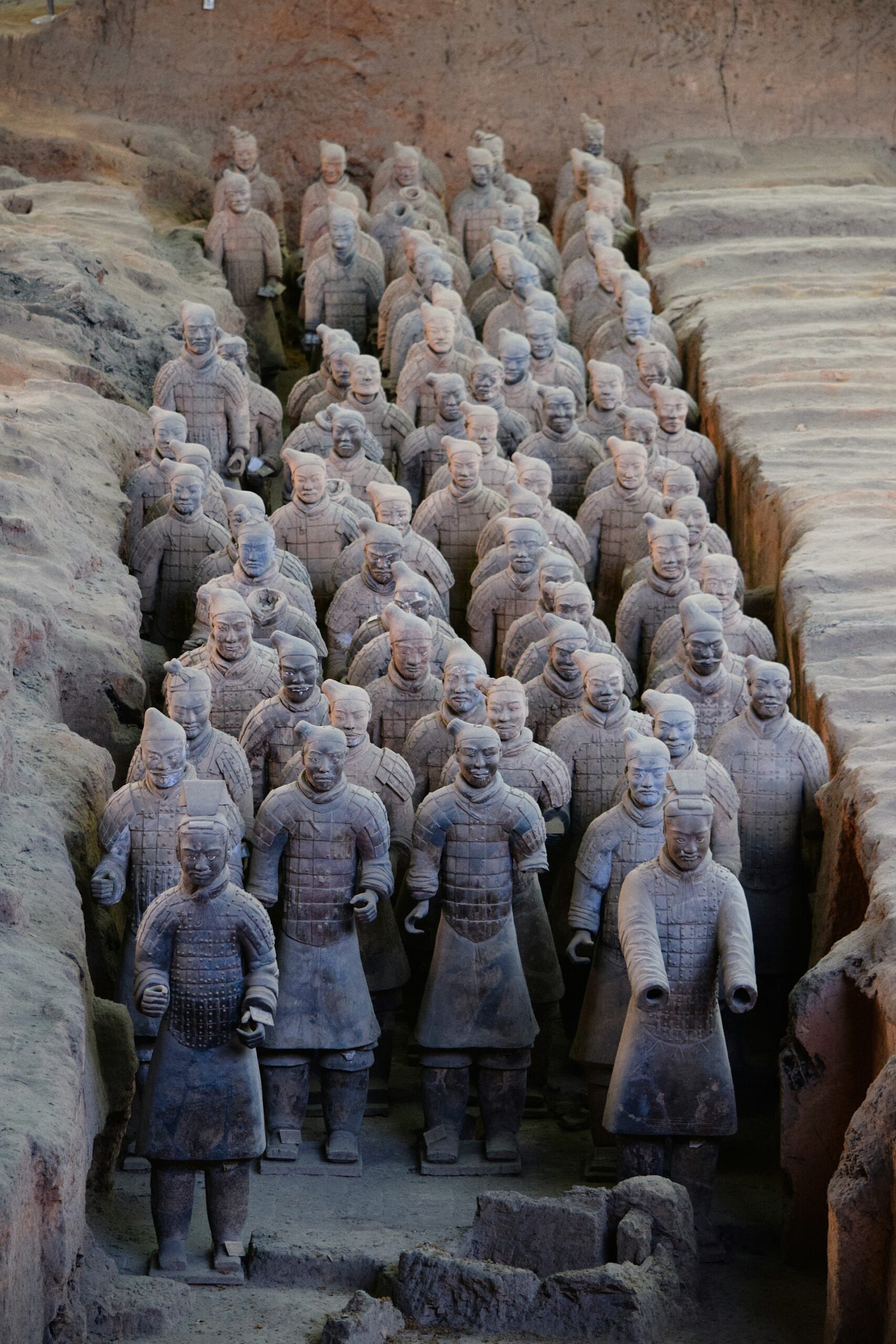
In the spring of 1974, while digging a well in the dusty fields near Lintong, Shaanxi Province, Chinese farmers struck something hard — not rock, but clay. What they unearthed would shake the world: thousands of life-sized warriors, horses, and chariots, standing frozen in formation beneath the earth — silent, stoic, eternal.
This was no myth. No legend. This was the Terracotta Army, the personal guard of Qin Shi Huang, China’s First Emperor — buried with him to protect his soul in the afterlife… and to ensure his rule continued beyond death.
But these are not mere statues. They are individuals — each with unique faces, expressions, armor styles, and even fingerprints left by their ancient sculptors. They were not mass-produced; they were handcrafted, imbued with identity, purpose, and haunting realism.
They never died — because they were never meant to live.

➤ 3.1 Discovery: From Farmers’ Dig to Global Sensation
April 23, 1974 — The Day History Was Unearthed
Three brothers — Yang Zhifa, Yang Qiaoxiang, and Yang Xinman — were digging a well when their shovels hit what felt like “stone men.” At first, they thought it was a temple ruin. Then came the heads. Then the torsos. Then the full figures — armored, weaponed, poised for battle.
Local officials alerted archaeologists. By May, experts from Beijing arrived. What they found stunned them:
“It’s like walking into a battlefield frozen in time.”
— Dr. Yuan Zhongyi, lead archaeologist at the site
By 1976, three massive pits had been uncovered:
🔹 Pit 1: The main force — over 6,000 soldiers, 520 horses, 130 chariots
🔹 Pit 2: Mixed units — cavalry, archers, infantry, command center
🔹 Pit 3: Headquarters — generals, officers, ceremonial guards
A fourth pit (Pit 4) was found empty — likely unfinished due to the empire’s collapse after Qin Shi Huang’s death.

➤ 3.2 Engineering Marvel: How They Were Made
These weren’t simple clay molds. They were masterpieces of industrial-scale artistry — blending mass production with individual craftsmanship.
🏭 Assembly Line Production
Archaeologists discovered that the army was made using modular techniques:
- Heads, torsos, arms, legs were molded separately
- Assembled on-site using wet clay slip as glue
- Each part stamped with maker’s mark — over 80 different workshops identified!
Think of it as ancient IKEA meets Roman legion — except every soldier was custom-fitted.

👁️ Facial Realism: No Two Faces Alike
Unlike Greek or Egyptian statues, which idealized beauty, the Terracotta Warriors reflect real people — farmers, conscripts, veterans, officers.
- Some have square jaws, others narrow chins
- Beards vary — some full, some trimmed, some clean-shaven
- Eyes are individually painted — many still retain traces of pigment
- Hairstyles differ — topknots, braids, buns — indicating rank or region
Modern facial recognition software has confirmed: no two warriors share identical features. Even fingerprints have been found on some figures — proof that real human hands shaped them.
⚔️ Weapons & Armor: Functional Artifacts
Over 40,000 bronze weapons were recovered — swords, spears, crossbows, arrowheads — many still sharp enough to cut paper.
🔹 Crossbow Mechanisms: Highly advanced triggers, some with interchangeable parts
🔹 Bronze Alloy: Tin content optimized for hardness and flexibility — comparable to modern steel
🔹 Corrosion Resistance: Coated with chromium oxide — a technique lost until the 20th century
Many weapons bear inscriptions naming the workshop and date — evidence of state-controlled quality control.
➤ 3.3 Symbolism & Purpose: Why an Army Beneath the Earth?
Qin Shi Huang didn’t just want to be remembered — he wanted to rule forever.
🌌 Cosmic Order: The Afterlife as Mirror of Earth
Ancient Chinese believed the afterlife mirrored the living world. To maintain power beyond death, one needed servants, treasures, and protection.
His tomb complex — larger than Manhattan — was designed as a microcosm of his empire:
- Mountains = artificial hills
- Rivers = mercury streams
- Palaces = underground chambers
- And the army? His eternal military machine.
He didn’t fear death — he feared being forgotten. So he built an immortal court.
“I am the Son of Heaven. My reign shall last ten thousand generations.”
— Inscription found near tomb entrance
🛡️ Military Formation: Battle Ready Forever
The army is arranged in precise battle formations — front lines of archers, flanks of cavalry, rear ranks of infantry, command centers protected by generals.
Even the direction they face matters: all look east — toward the lands he conquered, the enemies he defeated, the rivals who might challenge him even in death.
Their postures are rigid, disciplined — not relaxed, not resting. They are on duty. Always.
➤ 3.4 Mysteries & Legends: What Lies Beyond the Pits?
Despite decades of excavation, much remains hidden — deliberately so.
🧭 The Unopened Tomb Chamber
The central burial mound — where Qin Shi Huang’s body lies — has never been opened. Why?
- Soil tests show dangerously high levels of mercury — possibly simulating rivers of the underworld
- Ancient texts warn of booby traps: automatic crossbows, poisoned air, collapsing ceilings
- Modern technology detects vast underground structures — perhaps palaces, libraries, even mechanical automata
UNESCO and Chinese authorities agree: do not disturb. Too risky. Too sacred.
🔮 Myths of Immortality Within
Legends say inside the tomb:
- Bronze birds sing melodies of heaven
- Oil lamps burn eternally fueled by whale fat
- Mechanical guardians patrol corridors
- Maps of the universe carved into jade walls
Some believe the tomb contains the ultimate secret — not gold or jewels, but knowledge: alchemical formulas, star charts, forbidden histories.
“He who opens this tomb will awaken the wrath of the First Emperor.”
— Local folklore passed down through generations
➤ 3.5 Cultural Impact: From Archaeological Wonder to Global Icon
🎬 Hollywood & Pop Culture
The Terracotta Army has appeared in films (Indiana Jones and the Temple of Doom, The Mummy: Tomb of the Dragon Emperor), video games (Age of Empires II, Assassin’s Creed Chronicles: China), and even anime (Naruto, Attack on Titan).
In 2008, during the Beijing Olympics, giant replicas marched across the stadium — symbolizing China’s ancient glory meeting modern ambition.
🖼️ Artistic Influence
Artists worldwide have reimagined the warriors — in neon lights, digital avatars, street murals, fashion designs. One artist created a glass terracotta warrior that glows under UV light — merging ancient craft with futuristic tech.
🌍 Tourism Phenomenon
Over 10 million visitors per year flock to Xi’an to see the army — making it one of the most visited archaeological sites on Earth.
Visitors can walk along glass bridges above Pit 1, view 3D holograms of reconstruction, and even touch replica fragments (under strict supervision).
➤ 3.6 Legacy: Why These Soldiers Still Matter Today
💡 Proof of Ancient Innovation
The Terracotta Army proves that 2,200 years ago, China possessed:
- Industrial-scale manufacturing
- Advanced metallurgy
- Sophisticated logistics
- Psychological warfare (fear of eternal armies)
It challenges Western assumptions about “primitive” ancient civilizations.
📜 Cultural Continuity
China today still values discipline, hierarchy, unity — traits embodied by the army. Their silent vigil mirrors modern Chinese ideals: endurance, loyalty, collective strength.
Even in corporate culture, managers reference the “Terracotta mindset” — precision, uniformity, unwavering focus.
❤️ Human Connection Across Time
When you stand before a warrior — staring into eyes painted millennia ago — you feel something primal. Not awe of power, but empathy for the unknown artisan who shaped his brow, the soldier whose face inspired his expression, the emperor who dreamed of eternity.
They remind us: greatness leaves scars. Ambition demands sacrifice. And memory — if crafted well — can outlast empires.
➤ 3.7 Interactive Experience: Walk Among the Immortals
(Imagine stepping into a virtual reality exhibit)
📍 Step Into Pit 1: Walk among 6,000 soldiers — hear ambient sounds of clinking armor, distant drums, wind whispering through chariot wheels.
🎨 Design Your Own Warrior: Choose hairstyle, armor style, weapon type — then watch your creation join the ranks.
🗺️ Explore the Tomb Complex: Fly over the entire necropolis — see mercury rivers glow, watch robotic guardians activate, descend into the unopened burial chamber (simulated).
📜 Decode the Scrolls: Read translated excerpts from Qin legal codes, poetry banned during book burnings, and alchemist notes on immortality elixirs.
Conclusion: The Eternal Guardians
The Terracotta Army did not die — because they were never alive.
They are not statues. They are symbols — of ambition, control, fear, hope, and the desperate human desire to conquer time itself.
They guard not just a tomb — but the soul of a civilization that refused to fade.
“They stand not to fight wars — but to prove that one man’s vision can shape eternity.”
— Epigraph at the Museum Entrance
