The Fall of the Qin Dynasty — How the First Emperor’s Dream Crumbled
From Eternal Empire to Ashes in 15 Years: The Tragic Collapse of China’s First Imperial Dynasty
Introduction: The Iron Fist That Shattered Itself
Qin Shi Huang died in 210 BCE, convinced his empire would last “ten thousand generations.” He had unified China, standardized its soul, and built monuments to eternity. Yet within three years, rebellion erupted. Within fifteen, the dynasty he forged with blood and fire was gone — erased from power, vilified in history, and reduced to ruins.
This is not a tale of foreign invasion or natural disaster. It is the story of internal collapse — of hubris, betrayal, mismanagement, and the unbearable weight of tyranny. The Qin Dynasty didn’t fall because it was weak. It fell because it was too strong — too rigid, too cruel, too disconnected from the people it ruled.
In this chapter, we unravel how the greatest empire in human history at the time — one that reshaped civilization — crumbled faster than any other major dynasty in Chinese history. And why its collapse became the blueprint for every future ruler’s cautionary tale.
➤ 3.1 The Death of the First Emperor: A Coup in the Shadows
The Final Journey — Death on the Road
In the summer of 210 BCE, Qin Shi Huang embarked on his fifth inspection tour — seeking immortality, perhaps, or simply asserting control over distant provinces. He traveled eastward, stopping at the coastal city of Shandong, where he fell gravely ill.
His condition worsened rapidly. Some historians believe mercury poisoning from elixirs contributed; others point to exhaustion, stress, or even assassination. Whatever the cause, he died near Sandan (modern-day Linyi), aged just 49.
“He who commands ten thousand chariots cannot command his own fate.”
— Anonymous courtier, recorded in Records of the Grand Historian
The Secret Cover-Up: Li Si & Zhao Gao’s Treachery
Rather than announce the emperor’s death immediately, his chief minister Li Si and eunuch Zhao Gao conspired to conceal it — fearing chaos if news spread before they could secure succession.
They:
- Stuffed the corpse with salted fish to mask decomposition (a grim irony — the man who sought eternal life was disguised as rotting meat)
- Forged an edict ordering Crown Prince Fusu — the eldest son, known for his moderation and Confucian leanings — to commit suicide
- Installed Huhai, the younger, pliable son, as Qin Er Shi (“Second Emperor”)
This coup marked the beginning of the end.
📌 Why It Mattered:
Fusu was popular among generals and scholars. His removal alienated key factions. Huhai, easily manipulated by Zhao Gao, became a puppet — and Zhao Gao, the true power behind the throne, plunged the empire into paranoia and purges.
➤ 3.2 Qin Er Shi: The Puppet Emperor Who Accelerated Collapse
A Reign of Terror — Worse Than His Father
Where Qin Shi Huang ruled with cold efficiency, Qin Er Shi ruled with hysterical cruelty. Under Zhao Gao’s influence, he executed:
- His own siblings — including 12 brothers publicly beheaded in Xianyang
- High-ranking officials who questioned Zhao Gao
- Anyone suspected of disloyalty — real or imagined
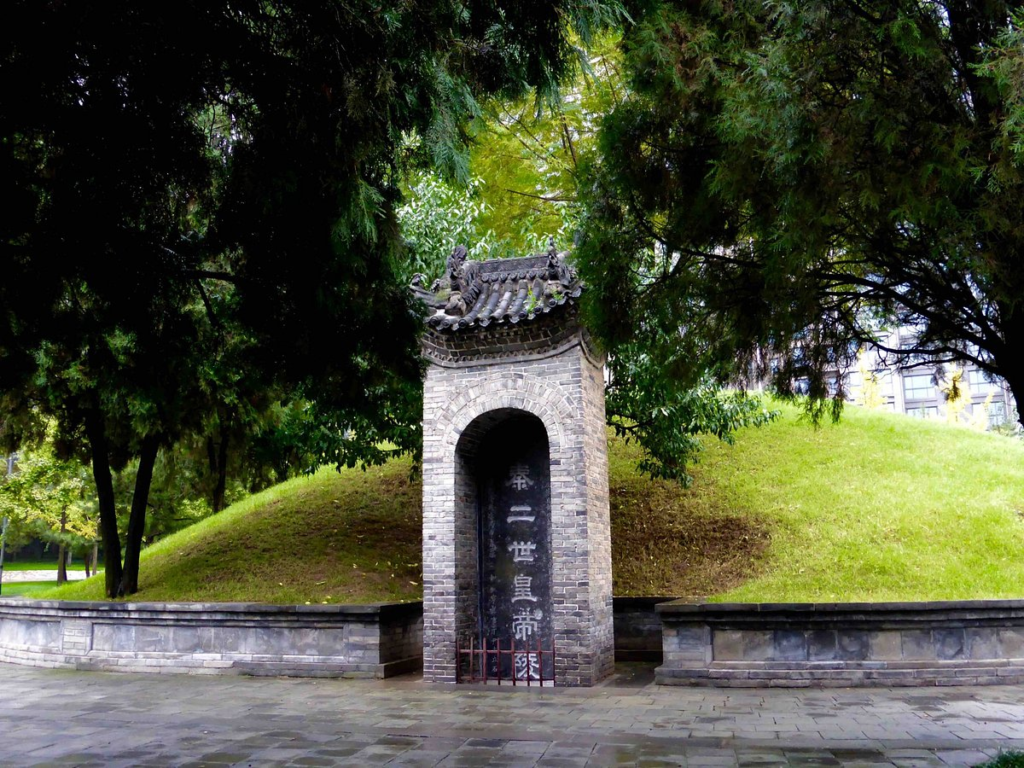
Even Li Si, once the architect of Qin’s legalist state, was eventually framed, tortured, and executed in 208 BCE — dying slowly via five punishments (amputation, castration, decapitation, dismemberment, and public display).
“When the ruler fears his ministers, the ministers fear the people. When the people have nothing left to lose, they rise.”
— Sima Qian, Records of the Grand Historian
Zhao Gao: The Eunuch Who Ruled the Empire
Zhao Gao wasn’t just a schemer — he was a master manipulator who weaponized fear. He famously tested loyalty by presenting a deer to the emperor and claiming it was a horse. Those who agreed were rewarded; those who disagreed were killed.
His reign of terror destabilized the bureaucracy, paralyzed decision-making, and destroyed morale among officials and soldiers alike.
By 207 BCE, Zhao Gao had effectively become the de facto ruler — until he forced Qin Er Shi to commit suicide after rebel armies approached the capital.
➤ 3.3 The Spark Ignites: Peasant Revolts and Warlord Uprisings
Chen Sheng & Wu Guang: The First Rebellion (209 BCE)
Just one year after Qin Shi Huang’s death, two low-ranking officers — Chen Sheng and Wu Guang — led a mutiny against Qin authority while stationed in Dazexiang (modern Anhui).
Their slogan?
“Are kings and generals born to rule?”
— Chen Sheng
This simple phrase shattered the myth of divine mandate. If commoners could challenge the emperor, then anyone could.
Though their rebellion was crushed within months, it ignited a wildfire across China.
The Rise of Warlords: Xiang Yu & Liu Bang
As peasant revolts spread, regional warlords emerged — former nobles, disgruntled generals, and opportunistic bandits.
Two figures rose above all:
🔹 Xiang Yu — noble-born, charismatic, brutal warrior-king of Chu. Commanded massive armies, defeated Qin forces in decisive battles, and embodied aristocratic resistance to Legalism.
🔹 Liu Bang — humble出身 (originally a village constable), clever, pragmatic, and deeply connected to the common people. Would later found the Han Dynasty.
These two men would clash in the Chu-Han Contention (206–202 BCE) — a civil war that decided China’s fate after Qin’s fall.
➤ 3.4 Military Overreach & Economic Collapse
Overextension: The Cost of Conquest
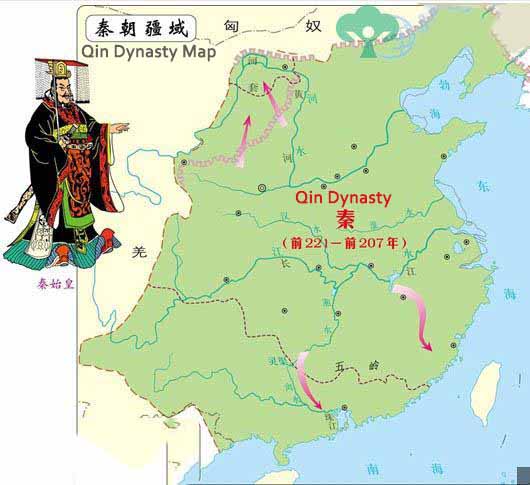
Qin Shi Huang’s empire stretched from the deserts of Gansu to the jungles of Guangdong — but maintaining it required unsustainable resources.
- Mass conscription: Millions drafted for labor projects (Great Wall, roads, canals) and military campaigns
- Heavy taxation: Farmers paid up to 50% of harvests to fund imperial ambitions
- Forced migration: Populations relocated to frontier zones to colonize newly conquered lands
By 209 BCE, famine plagued rural areas. Fields lay fallow. Families starved. Soldiers deserted.
Infrastructure Without Sustainability
While Qin’s roads and canals were engineering marvels, they served imperial logistics — not local economies. There was no welfare system, no disaster relief, no safety net.
When floods hit the Yellow River or drought struck Sichuan, there was no mechanism to respond — only more demands for grain and labor.
The result? Widespread resentment turned into open revolt.
➤ 3.5 Cultural Backlash: The Rejection of Legalism
Confucianism vs. Legalism — Ideological Warfare
Qin Shi Huang suppressed Confucianism, burning texts and executing scholars. But Confucian ideals — filial piety, moral governance, benevolence — never died. They simmered underground, especially among educated elites and regional gentry.
After his death, these groups rallied around rebel leaders like Chen Sheng and later Liu Bang, framing the rebellion as a righteous restoration of virtue against tyranny.
“The Qin used punishment to govern, forgetting compassion. Thus, though they conquered the world, they lost the hearts of the people.”
— Jia Yi, Han Dynasty scholar
Legitimacy Lost
Unlike later dynasties that claimed Mandate of Heaven through ritual and virtue, Qin relied solely on force and fear. When the army faltered, so did legitimacy.
Rebels didn’t just fight for territory — they fought for moral redemption. They painted Qin as illegitimate, unjust, and unnatural — a regime that defied cosmic order.
➤ 3.6 The Final Days: Siege of Xianyang & Burning of the Palace
Fall of the Capital (207 BCE)
In late 207 BCE, rebel forces led by Liu Bang reached Xianyang, the Qin capital. Zhao Gao had already forced Qin Er Shi to commit suicide and installed a puppet king — Ziying, a grandson of Qin Shi Huang.
Ziying surrendered peacefully — hoping to preserve some dignity. But Liu Bang refused mercy.
Within days, Xianyang was sacked. The magnificent Epang Palace — said to cover over 5 square kilometers, with halls so vast they housed entire forests — was burned to the ground.
“The flames consumed not just wood and stone, but the dream of eternal empire.”
— Sima Qian
Archaeologists today still find layers of ash and melted bronze beneath the ruins — evidence of the catastrophic fire that ended the Qin era.
➤ 3.7 Legacy of Failure: Why the Qin Collapsed So Fast
Three Fatal Flaws
- Too Much Too Soon
Qin tried to impose uniformity overnight — language, law, currency, thought. Human societies don’t change that fast without backlash. - No Succession Plan
Qin Shi Huang never formally named an heir — trusting fate, astrology, and his own longevity. His sudden death created a vacuum filled by treachery. - Rule Through Fear Alone
Without loyalty, love, or shared values, regimes based purely on terror collapse when pressure mounts. Qin had no cushion — only spikes.
➤ 3.8 What Survived? The Paradox of the Qin’s Enduring Influence
Despite its rapid demise, the Qin Dynasty left indelible marks on Chinese civilization:
✅ Bureaucratic Model: The county system endured — adopted and refined by the Han, Tang, Song, Ming, Qing.
✅ Standardization: Writing, weights, measures — still foundational today.
✅ Centralized Authority: Every subsequent dynasty saw itself as heir to Qin’s unification project.
✅ Cautionary Tale: Later emperors studied Qin’s fall obsessively — avoiding excessive taxation, suppressing dissent too harshly, or ignoring peasant grievances.
“Learn from Qin’s mistakes — but keep its structure.”
— Emperor Wu of Han, founder of the Han golden age
➤ 3.9 Timeline: The Rapid Descent (210–206 BCE)
(Interactive Scroll View)
📅 210 BCE – Death of Qin Shi Huang
Concealed by Li Si and Zhao Gao. Fusu ordered to commit suicide.
📅 209 BCE – Chen Sheng & Wu Guang Rebellion Begins
First major uprising. Sparks nationwide revolts.
📅 208 BCE – Execution of Li Si
Zhao Gao eliminates last major check on his power.
📅 207 BCE – Qin Er Shi Forced to Commit Suicide
Zhao Gao installs Ziying as puppet king.
📅 Late 207 BCE – Liu Bang Enters Xianyang
Capital falls. Epang Palace burned.
📅 206 BCE – Ziying Surrenders, Qin Dynasty Officially Ends
Liu Bang declares himself King of Han. Civil war begins.
📅 202 BCE – Liu Bang Defeats Xiang Yu
Founding of the Han Dynasty — ushering in 400 years of stability.
Conclusion: The Lesson of the First Empire
The Qin Dynasty lasted only 15 years — shorter than many modern presidencies. Yet its impact echoes louder than most dynasties that lasted centuries.
It proved that unification is possible, but governance must be humane.
That centralization works, but must adapt to local realities.
That power can conquer, but only justice can sustain.
Qin Shi Huang dreamed of eternity — and failed. But in failing, he taught China how to endure.
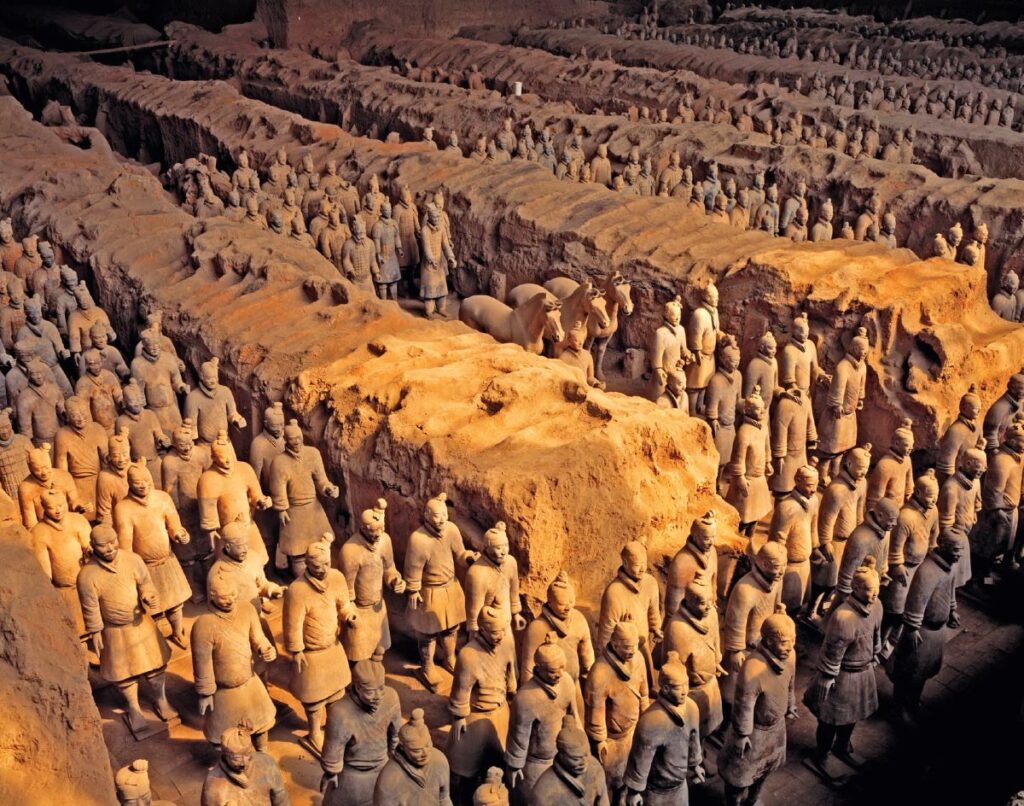
His tomb still guards his secrets beneath layers of mercury and earth. His terracotta warriors stand frozen in silent vigil. And his legacy lives on — not in glory, but in warning.
“He who builds without foundation will see his tower fall. He who rules without heart will see his people rise.”
— Ancient proverb, carved into Han stele
Next Stop: The Rise of the Han Dynasty — Restoring Order Through Wisdom
