
Unmasking the First Emperor: Architect of Modern China, Tyrant of Legend
Introduction: Beyond the Terracotta Warriors
When most people hear “Qin Shi Huang,” they picture an army of silent clay soldiers frozen in eternal vigil — or perhaps a paranoid despot obsessed with immortality, burning books and burying scholars alive. But behind the myth lies a man whose vision reshaped the very soul of China — politically, culturally, and geographically. He was not just a king; he was the First Emperor, the architect of a unified empire that would endure for over two millennia.
This is the story of Ying Zheng — the boy-king who conquered six warring states, forged a single nation from chaos, and imposed order so absolute it still echoes in modern Chinese governance. To understand China today — its language, its bureaucracy, its sense of national identity — you must first understand Qin Shi Huang.
➤ 2.1 Who Was Qin Shi Huang?
Birth and Early Life: From Obscure Prince to Ruthless Ruler
Born Ying Zheng in 259 BCE in Handan, the capital of the state of Zhao, he was the son of King Zhuangxiang of Qin and Lady Zhao. His early life was marked by danger and exile — his father was a hostage in Zhao, and young Zheng spent his first years there under threat of execution. When his father returned to Qin and ascended the throne, Zheng was sent back as crown prince at age 9.
At 13, upon his father’s death, he became King Zheng of Qin, but real power rested in the hands of regents and court officials — notably Lü Buwei, his mother’s lover and chancellor. It wasn’t until 221 BCE, after eliminating political rivals and consolidating authority, that Zheng declared himself Qin Shi Huangdi — “First Emperor of Qin.”
“I am the First Emperor. After me shall come the Second, Third… unto ten thousand generations.”
— Qin Shi Huang, upon unifying China
Unification of China: Ending the Warring States Era
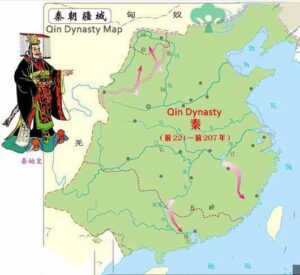
For centuries, China had been fractured into seven major kingdoms locked in endless warfare — the Warring States Period (475–221 BCE). Qin, though geographically western and once considered barbaric, had become the most militarized and bureaucratically efficient state under Legalist reforms.
Between 230 and 221 BCE, King Zheng launched a series of lightning campaigns:
- 230 BCE: Conquered Han
- 228 BCE: Defeated Zhao
- 225 BCE: Annihilated Wei
- 223 BCE: Crushed Chu
- 222 BCE: Subdued Yan and Dai
- 221 BCE: Annexed Qi — the final holdout
With the fall of Qi, China was unified for the first time in history under one ruler — Qin Shi Huang.
Why “First Emperor” Mattered
Before him, rulers were kings (wang) or lords (gong). None dared claim supremacy over all under heaven. By adopting the title Huangdi (皇帝) — combining Huang (“august,” from mythical sovereigns) and Di (“divine ruler,” from ancient god-kings) — he created a new concept: the Emperor, divine, absolute, eternal.
This wasn’t just semantics — it was ideological revolution. He claimed cosmic legitimacy, positioning himself as the center of the universe, above even the heavens. His reign established the template for every future emperor — from Han Wu to Qianlong to Puyi.
Personality: Visionary or Villain?
Historians have long debated whether Qin Shi Huang was a genius reformer or a monstrous tyrant. The truth? He was both.
✅ Visionary Leader:
- Created the first centralized bureaucratic state in world history
- Standardized systems that enabled trade, communication, and administration across vast territories
- Built infrastructure projects that shaped China’s geography for centuries
❌ Ruthless Reformer:
- Executed dissenters without trial
- Burned texts deemed subversive
- Forced millions into labor camps for monumental projects
- Persecuted Confucian scholars while elevating Legalism
His personality was complex — brilliant, paranoid, ambitious, and deeply insecure. He feared assassination (hence moving constantly between palaces), distrusted advisors (executing many), and sought immortality obsessively — a sign of profound existential dread beneath his imperial façade.
➤ 2.2 Major Achievements: Foundations of Imperial China
Standardization: The Glue That Held China Together
One of Qin Shi Huang’s greatest legacies was standardization — a radical, top-down restructuring of society to ensure control and efficiency.
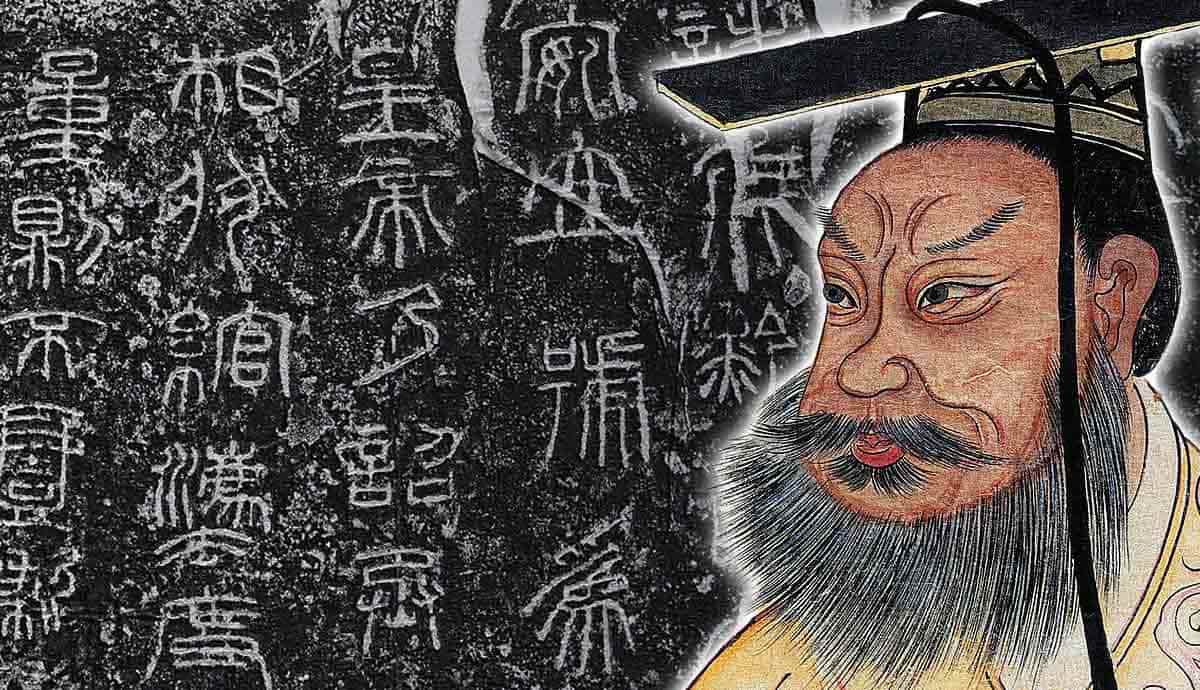
🔹 Writing System: Unified script from regional variants into Small Seal Script — the ancestor of modern Chinese characters. This allowed communication across dialects and laid groundwork for cultural cohesion.
🔹 Currency: Replaced barter and local coinage with round copper coins with square holes — the iconic “cash” used for 2,000 years.
🔹 Weights & Measures: Introduced uniform standards for length, volume, and weight — essential for taxation, trade, and military logistics.
🔹 Axle Widths: Mandated standardized cart axle widths so roads could accommodate all vehicles — facilitating troop movement and commerce.
These weren’t mere conveniences — they were tools of empire-building. Without them, China might never have remained unified.
Infrastructure: Building the Bones of an Empire
Qin Shi Huang didn’t just conquer land — he transformed it.
🚧 The Great Wall (Early Sections)
While often credited with “building” the Great Wall, he actually connected and reinforced existing walls built by earlier states (especially Qin, Zhao, and Yan). Stretching over 3,000 miles, it protected northern borders from nomadic invasions — a symbol of unity and defense.
🛣️ Imperial Roads & Canals
He ordered construction of imperial highways radiating from Xianyang (his capital) to every corner of the empire — some paved with stone, others lined with trees. These roads enabled rapid troop deployment and administrative oversight.
💧 Lingqu Canal (214 BCE)
A marvel of ancient engineering, this canal linked the Yangtze River basin with the Pearl River system — enabling grain transport to southern armies and integrating the rebellious Lingnan region (modern Guangdong/Guangxi).
Centralized Bureaucracy: Birth of the Mandarinate
Before Qin, China operated through feudal lords and hereditary nobles. Qin Shi Huang dismantled this system.
🏛️ County System (Junxian Zhi)
Replaced feudal fiefs with commanderies (jun) and counties (xian) governed by appointed officials loyal only to the emperor. No more autonomous warlords — only bureaucrats answerable to the throne.
⚖️ Legalist Governance
Based on the philosophy of Han Feizi, laws were harsh, uniform, and applied equally — even to nobles. Rewards for merit, punishments for failure. No mercy, no exceptions.
This structure became the blueprint for every dynasty that followed — including the Han, Tang, Song, Ming, and Qing. Even today’s Chinese civil service traces its roots to Qin’s meritocratic ideal.
➤ 2.3 Controversies & Myths: The Dark Side of Immortality
Burning of Books & Burying of Scholars (213–212 BCE)
In 213 BCE, at the urging of his prime minister Li Si, Qin Shi Huang ordered the destruction of historical records, philosophical texts, and poetry — except those related to medicine, agriculture, and divination.
Why? Because scholars criticized his rule using ancient precedents — especially Confucian classics that glorified past dynasties and emphasized moral governance over brute force.
In 212 BCE, after alchemists failed to deliver immortality elixirs, he allegedly executed 460 scholars — some say buried alive — though modern historians debate whether this was literal or symbolic punishment.
📌 Myth vs Reality:
The event has been exaggerated over time. Many texts survived in private collections or foreign lands. Still, it remains a powerful symbol of censorship and intellectual suppression.
Obsession with Immortality: Alchemists, Elixirs, and Expeditions
As he aged, Qin Shi Huang grew increasingly terrified of death. He funded expeditions to find the mythical Islands of the Immortals off China’s eastern coast.
🌊 Xu Fu’s Voyage (210 BCE)
He dispatched the alchemist Xu Fu with 3,000 boys and girls aboard fleets seeking the elixir of life. They vanished — legend says they reached Japan, founding the Yamato line. No trace was ever found.
🧪 Toxic Elixirs
He consumed mercury-laced pills believing they granted longevity — instead accelerating his decline. Recent soil tests near his tomb show dangerously high mercury levels — suggesting he may have literally poisoned himself chasing eternity.
The Underground Palace: Tomb of Eternal Power
His mausoleum — discovered in 1974 — is one of the greatest archaeological finds in human history.
📍 Location: Near Xi’an, Shaanxi Province
📍 Size: Over 20 square miles — larger than Manhattan
📍 Features:
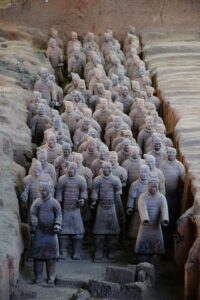
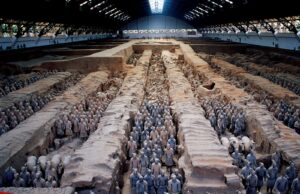
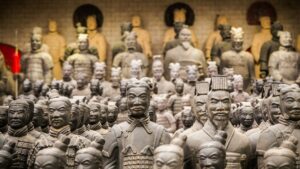
- Terracotta Army: 8,000+ life-sized soldiers, horses, chariots — each unique facial features
- Mercury Rivers: Simulated rivers of liquid mercury representing China’s waterways
- Underground Palace: Allegedly untouched, filled with treasures, traps, and mechanical crossbows
Archaeologists have yet to enter the core burial chamber due to radiation risks and preservation concerns. Legends say it contains bronze birds that sing, lamps fueled by whale oil that burn forever, and booby traps designed to kill intruders.
“He who dies does not die if his name lives on.”
— Ancient inscription near his tomb
➤ 2.4 Timeline of His Life (Interactive Infographic)
(Imagine scrolling through a vertical timeline with animated transitions)
📅 259 BCE – Birth
Born Ying Zheng in Handan, Zhao. Son of King Zhuangxiang and Lady Zhao.
📅 246 BCE – Ascends Throne
Becomes King Zheng of Qin at age 13. Regency begins under Lü Buwei.
📅 238 BCE – Seizes Power
Executes Lü Buwei and嫪毐 (his mother’s lover). Assumes full control.
📅 230–221 BCE – Conquests Begin
Systematically conquers Han, Zhao, Wei, Chu, Yan, Qi — ends Warring States era.
📅 221 BCE – Declares Himself First Emperor
Adopts title Qin Shi Huangdi. Establishes centralized empire.
📅 220–210 BCE – Reforms & Construction
- Standardizes writing, currency, weights, measures
- Builds roads, canals, connects Great Wall sections
- Begins construction of mausoleum and terracotta army
📅 213 BCE – Book Burning Edict
Orders destruction of non-state-approved texts.
📅 212 BCE – Scholar Executions
Punishes critics; rumored mass burials begin.
📅 210 BCE – Death & Legacy
Dies during inspection tour at age 49. Body secretly returned to Xianyang. Successor Huhai (Qin Er Shi) takes throne — but empire collapses within 4 years.
Conclusion: Why He Still Matters Today
Qin Shi Huang did not merely unify China — he invented the idea of China as a singular, enduring civilization. His innovations in governance, language, infrastructure, and ideology became the DNA of imperial China.
Modern China still uses standardized characters, operates under a centralized bureaucracy, and views national unity as sacred — all legacies of Qin Shi Huang.
Was he cruel? Undoubtedly.
Was he visionary? Absolutely.
Was he flawed? Humanly so.
But without him, China — and perhaps East Asia itself — would look radically different.
He stands not as a myth, nor as a monster — but as a transformative force of history: the man who made China what it is.
Visit Our Interactive Exhibit:
👉 Explore 3D reconstructions of his tomb
👉 Compare ancient scripts before/after standardization
👉 Walk the virtual “Imperial Highway” from Xianyang to Guangzhou
👉 Decode legal codes that governed millions
“All under heaven belongs to one family.”
— Qin Shi Huang, 221 BCE
Next Stop: The Fall of the Qin Dynasty — How the First Emperor’s Dream Crumbled