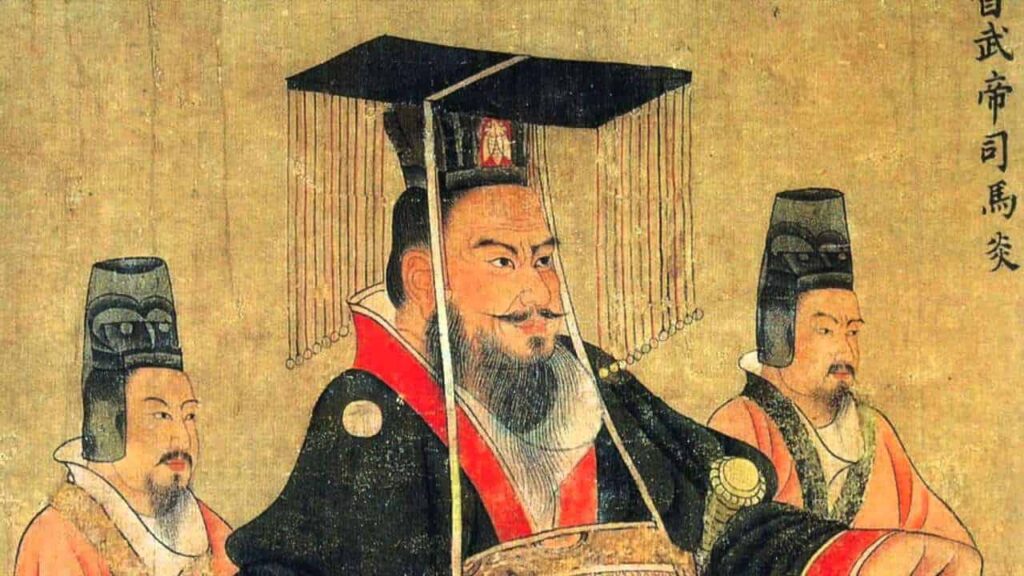

Introduction: From Ashes of Tyranny to Foundations of Harmony
In 207 BCE, just four years after the death of Qin Shi Huang, the mighty Qin Empire — built on iron discipline, fear, and forced labor — collapsed under its own weight. Rebellions erupted across the land. Peasants turned warriors. Warlords carved up the empire. And from this chaos emerged not another tyrant, but a man who would become one of China’s most revered rulers: Liu Bang, founder of the Han Dynasty.
Where Qin had ruled by terror, Han would rule by wisdom.
Where Qin had burned books, Han would revive them.
Where Qin had crushed dissent, Han would embrace Confucianism — not as dogma, but as governance.
This is the story of how China rose from the ashes of tyranny — not through brute force alone, but through pragmatism, philosophy, and political genius. It is the tale of a dynasty that lasted 400 years (206 BCE – 220 CE), shaped Chinese identity, expanded borders, and laid the cultural, bureaucratic, and moral foundations for every future imperial state — including modern China.
➤ 3.1 The Fall of Qin: When Tyranny Met Its Match
The Cracks Beneath the Imperial Facade
Qin Shi Huang’s death in 209 BCE triggered a power struggle among his heirs. His son Qin Er Shi was weak, manipulated by the eunuch Zhao Gao, who eventually forced him to commit suicide. Meanwhile, rebellions flared:
- Chen Sheng & Wu Guang (209 BCE): Two conscripted peasants led the first major revolt — “Are kings and generals born to rule?” they cried — challenging the divine right of emperors.
- Xiang Yu: A noble warrior from Chu, charismatic and fierce, became the symbol of anti-Qin resistance.
- Liu Bang: A minor village official with no noble blood, known for drinking, gambling, and charisma — yet possessing an uncanny ability to win loyalty.
The Battle of Julu (207 BCE) — Turning Point of History
At Julu, Xiang Yu’s forces annihilated the main Qin army — sealing the dynasty’s fate. But while Xiang Yu was a brilliant general, he lacked political vision. He slaughtered surrendered soldiers, alienated allies, and failed to consolidate power.
Meanwhile, Liu Bang captured the Qin capital Xianyang without sacking it — earning praise for restraint. He issued a simple decree: “The Three Prohibitions”:
- No killing of civilians
- No looting of homes
- No raping of women
His humility, pragmatism, and appeal to commoners made him the people’s choice — even if he didn’t look like a king.
“I am not better than others — I simply know how to use men.”
— Liu Bang, reflecting on his rise
➤ 3.2 Liu Bang: The Peasant Who Became Emperor
From Drunkard to Divine Mandate
Born into poverty in 256 BCE in Pei County (modern Jiangsu), Liu Bang served as a low-ranking constable before joining the rebellion. Unlike Xiang Yu — whose arrogance cost him everything — Liu Bang surrounded himself with talented advisors:
- Xiao He – administrative genius, organized logistics and law
- Cao Can – military strategist
- Zhang Liang – master tactician, philosopher, and diplomat
- Han Xin – brilliant general who won key battles despite being underestimated
Together, they formed what historians call “The First Han Triumvirate” — combining military might, bureaucratic efficiency, and philosophical insight.
The Chu-Han Contention (206–202 BCE)
After Qin’s fall, Xiang Yu declared himself “Hegemon-King of Western Chu,” dividing China into feudal states. Liu Bang, granted the remote region of Hanzhong, used it as a base to rebuild. Over four years, he outmaneuvered Xiang Yu through diplomacy, espionage, and battlefield cunning.
The final showdown came at Gaixia (202 BCE). Surrounded, Xiang Yu sang a mournful song to his concubine Yu Ji before committing suicide. Liu Bang emerged victorious — not just as conqueror, but as unifier.
On February 28, 202 BCE, he ascended the throne as Emperor Gaozu of Han, founding the Western Han Dynasty.
➤ 3.3 Governance Philosophy: From Legalism to Confucian Synthesis
Rejecting Qin’s Harshness
The Han learned from Qin’s mistakes. While Qin ruled by punishment and fear, Han sought stability through benevolence — but not naivety. They blended ideologies:
🔹 Confucian Ethics: Moral leadership, filial piety, ritual propriety — restored after Qin’s suppression
🔹 Legalist Structure: Centralized bureaucracy, standardized laws, merit-based appointments
🔹 Daoist Flexibility: Non-interference (wu wei) in local affairs, allowing regional autonomy where possible
This hybrid model — sometimes called “Confucian-Legalism” or “Han Syncretism” — became the enduring framework of Chinese governance.
The Grand Historian Sima Qian: Chronicler of Truth
Under Emperor Wu (r. 141–87 BCE), historian Sima Qian wrote the Records of the Grand Historian (Shiji) — the first comprehensive history of China, covering legends to his own time. His work preserved Qin’s achievements while condemning its cruelty — setting a precedent for historical accountability.
“History is the mirror of the past; let it reflect truth, not flattery.”
— Sima Qian
➤ 3.4 Major Achievements of the Han Dynasty
Administrative Innovations: Building the Bureaucratic State
✅ Civil Service Examination System (Early Form)
Though fully formalized later during the Sui-Tang, Han began selecting officials based on merit — not birth. Candidates studied Confucian classics, tested on ethics and governance.
✅ Nine-Rank System
A classification system for officials based on performance and virtue — precursor to later imperial exams.
✅ County-Commandery System Refined
Retained Qin’s structure but softened it — allowed local elites to participate in governance, reducing resentment.
Economic Revival & Infrastructure
💰 Currency Reform
Replaced Qin’s heavy copper coins with lighter, more practical wuzhu coins — stable currency used for 700 years.
🌾 Land Redistribution
To prevent peasant revolts, Han redistributed land confiscated from Qin nobles — giving small farmers ownership rights.
🚧 Roads, Canals, Granaries
Expanded Qin’s road network, built new canals, established state granaries to store grain for famine relief — creating economic resilience.
Cultural Renaissance: Confucianism as State Ideology
In 136 BCE, Emperor Wu officially adopted Confucianism as the state ideology — though selectively. He promoted:
- Imperial Academy (Taixue): First national university teaching Confucian texts
- Five Classics: Canonized texts including Book of Songs, Spring and Autumn Annals
- Moral Education: Officials required to demonstrate virtue, loyalty, and filial piety
This cemented Confucian values — hierarchy, harmony, duty — into Chinese society for millennia.
Military Expansion & Foreign Relations
🌍 Silk Road Opens (138 BCE)
Emperor Wu sent Zhang Qian on diplomatic missions to Central Asia — establishing trade routes that connected China to Persia, India, and Rome. Silk, jade, horses, spices, and ideas flowed both ways.
⚔️ Wars Against the Xiongnu
Nomadic tribes from the north plagued Han borders. Generals like Wei Qing and Huo Qubing launched campaigns deep into Mongolia, securing northern frontiers and expanding territory.
🛡️ Fortifications Reinforced
Built upon Qin’s Great Wall, adding watchtowers, beacon systems, and garrison towns — turning it into a living defense system.
➤ 3.5 Controversies & Complexities: Not All Was Golden
Empress Lü Zhi: The Iron Lady Behind the Throne
After Liu Bang’s death in 195 BCE, his widow Empress Lü Zhi seized power — becoming China’s first female ruler in practice (though never formally emperor). She executed rivals, installed puppet kings, and ruled ruthlessly — proving women could wield imperial authority, albeit controversially.
Her reign ended violently — her clan was massacred in 180 BCE by loyalists who restored Liu family rule.
Emperor Wu’s Costly Ambitions
While Emperor Wu expanded Han’s glory, his wars drained the treasury. Heavy taxation, conscription, and inflation caused suffering. By his later years, he issued the Edict of Self-Criticism (Luntai Edict, 89 BCE) — admitting mistakes and vowing to reduce military campaigns.
“I have brought ruin upon my people. I repent.”
— Emperor Wu
This rare act of public contrition set a moral precedent for future emperors.
The Wang Mang Interlude (9–23 CE)
After Emperor Wu’s line weakened, the regent Wang Mang usurped the throne in 9 CE, claiming to restore ancient Zhou ideals. His radical reforms — land redistribution, currency changes, abolition of slavery — backfired catastrophically. Rebellion erupted, and he was killed in 23 CE. The Han restored power — now known as the Eastern Han (25–220 CE).
➤ 3.6 Timeline of the Han Dynasty (Interactive Infographic)
(Imagine scrolling through a vertical timeline with animated transitions)
📅 206 BCE – Founding of Western Han
Liu Bang defeats Xiang Yu, establishes capital at Chang’an.
📅 202 BCE – Liu Bang Crowned Emperor Gaozu
Begins reconstruction, adopts lenient policies.
📅 195 BCE – Death of Liu Bang
Empress Lü Zhi assumes regency.
📅 180 BCE – Restoration of Liu Line
Lü clan overthrown; Emperor Wen takes throne.
📅 156–141 BCE – Reign of Emperor Jing
Stabilizes economy, reduces taxes, suppresses rebellion.
📅 141–87 BCE – Reign of Emperor Wu
Golden Age: Silk Road opens, Confucianism institutionalized, military expansion peaks.
📅 9–23 CE – Wang Mang’s Xin Dynasty
Usurpation, failed reforms, collapse.
📅 25 CE – Eastern Han Founded
Emperor Guangwu restores Han, moves capital to Luoyang.
📅 184 CE – Yellow Turban Rebellion
Massive Daoist-led uprising signals decline.
📅 220 CE – End of Han
Last emperor abdicates; Three Kingdoms period begins.
Conclusion: Why the Han Still Define China Today
The Han Dynasty didn’t just survive — it thrived. For 400 years, it created institutions, values, and symbols that still define Chinese civilization:
🇨🇳 Ethnic Identity: The term “Han” became synonymous with ethnic Chinese — over 90% of China’s population today identifies as Han.
📚 Education System: Confucian academies evolved into imperial examinations — influencing East Asian education for centuries.
🌐 Global Influence: Through the Silk Road, Han introduced Chinese silk, paper, philosophy, and technology to the world.
⚖️ Governance Model: The balance of centralized control and moral legitimacy remains embedded in modern Chinese political thought.
Qin Shi Huang gave China unity.
Han gave China soul.
Where Qin demanded obedience, Han invited participation.
Where Qin feared dissent, Han cultivated consensus.
Where Qin died with its emperor, Han lived beyond its dynasties.
Visit Our Interactive Exhibit:
👉 Step into the Han Court: Witness Emperor Wu receiving Zhang Qian’s report from the West
👉 Decode Confucian scrolls in the Imperial Academy
👉 Walk the Silk Road virtually — from Chang’an to Samarkand
👉 Compare Qin vs. Han legal codes side-by-side
“The Han did not erase the Qin — they redeemed it.”
— Modern historian Li Feng
Next Stop: The Three Kingdoms — When Unity Shattered Again