📜 An Ancient Mystery Buried for 2,200 Years
In 1974, a group of farmers digging a well in Lintong District, near Xi’an, China, stumbled upon one of the most extraordinary archaeological discoveries in human history — the Terracotta Army 🗿. Over 8,000 life-sized clay soldiers, horses, and chariots lay buried in vast pits, silently guarding the tomb of Qin Shi Huang, the first Emperor of China (259–210 BCE).
For decades, scholars have marveled at the artistry, scale, and precision of these figures. But one question lingered like a shadow: Who actually made them? 👤
Now, thanks to cutting-edge forensic analysis of ancient fingerprints left in the clay, scientists are finally pulling back the curtain on the identities of the craftsmen behind this monumental feat. 🔍
🏺 The Terracotta Army: A Monument Like No Other
Before diving into the fingerprint revelations, it’s essential to understand the sheer magnitude of the project:
| 📊 Feature | Details |
|---|---|
| 🗿 Number of Warriors | ~8,000 (estimated) |
| 🐴 Horses | ~670 |
| 🛞 Chariots | ~130 |
| 📏 Average Height | 1.8 m (5 ft 11 in) |
| ⚖️ Average Weight | ~136 kg (300 lbs) |
| 📅 Construction Period | ~246–208 BCE |
| 👷 Estimated Workforce | ~700,000 laborers |
Each warrior is unique — no two faces are identical. They display distinct facial features, hairstyles, armor designs, and expressions, suggesting they were modeled after real individuals or crafted by different artisans with personal styles. 🎭
The army was arranged in battle formation across three massive pits, covering an area of over 56 square kilometers — an underground empire frozen in clay. ⚔️
🔎 The Breakthrough: Reading Fingerprints in Clay
🖐️ How Fingerprints Survived 2,200 Years
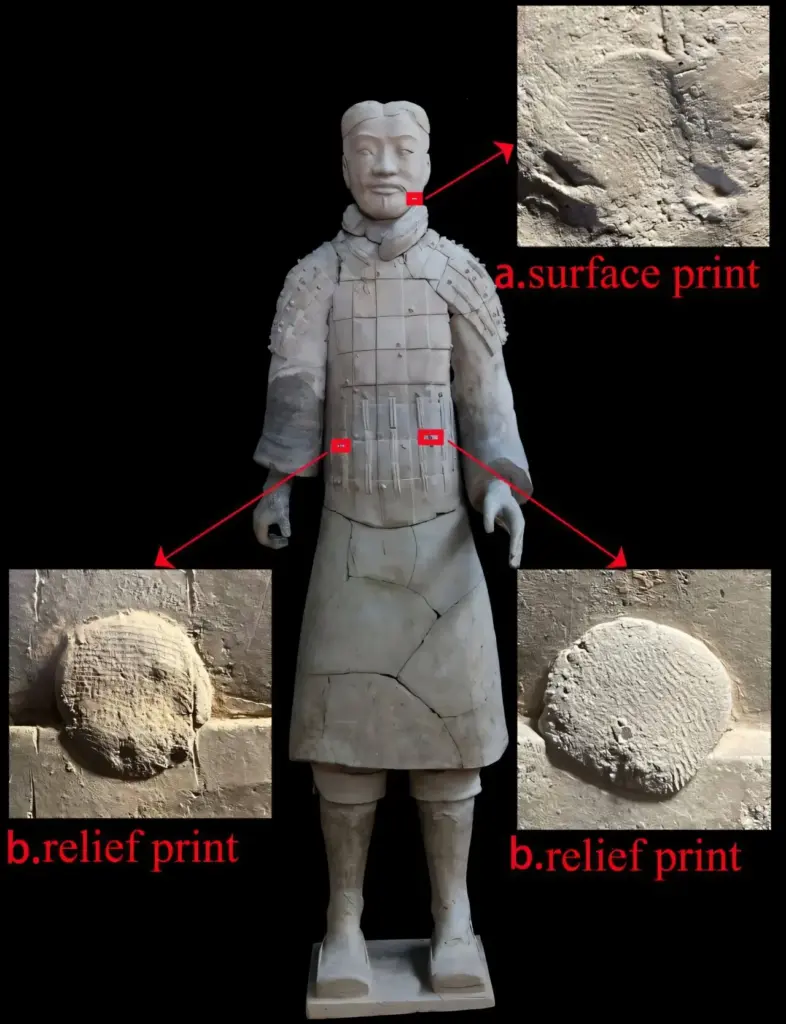
When the ancient artisans shaped the wet clay, their fingertips, palms, and thumbs pressed naturally into the material. As the clay was fired in kilns at temperatures exceeding 1,000°C (1,832°F) 🔥, these impressions became permanently locked into the ceramic surface — essentially turning each figure into an ancient biometric record.
These prints were hidden beneath layers of lacquer, paint, and centuries of soil, making them invisible to the naked eye. 👁️
🔬 Modern Forensic Techniques Applied to Ancient Art
In recent years, researchers — including teams from University College London (UCL), the Emperor Qin Shi Huang’s Mausoleum Site Museum, and forensic anthropologists — have employed advanced methods to extract and analyze these prints:
- 📸 High-resolution 3D scanning and photogrammetry to capture surface details
- 🔍 Silicone casting to lift fingerprints without damaging the artifacts
- 🧪 Digital enhancement using multispectral imaging
- 📐 Ridge pattern analysis using forensic classification systems (loops, whorls, arches)
- 🤖 AI-assisted matching to identify repeat prints from the same individual
“These fingerprints are as unique today as they were two millennia ago. They are the literal touch of the people who built this army.” — Dr. Patrick Randolph-Quinney, Forensic Anthropologist 🧑🔬
👦👨 Key Revelations: Who Were the Craftsmen?
1. 🧒 Surprisingly Young Workers
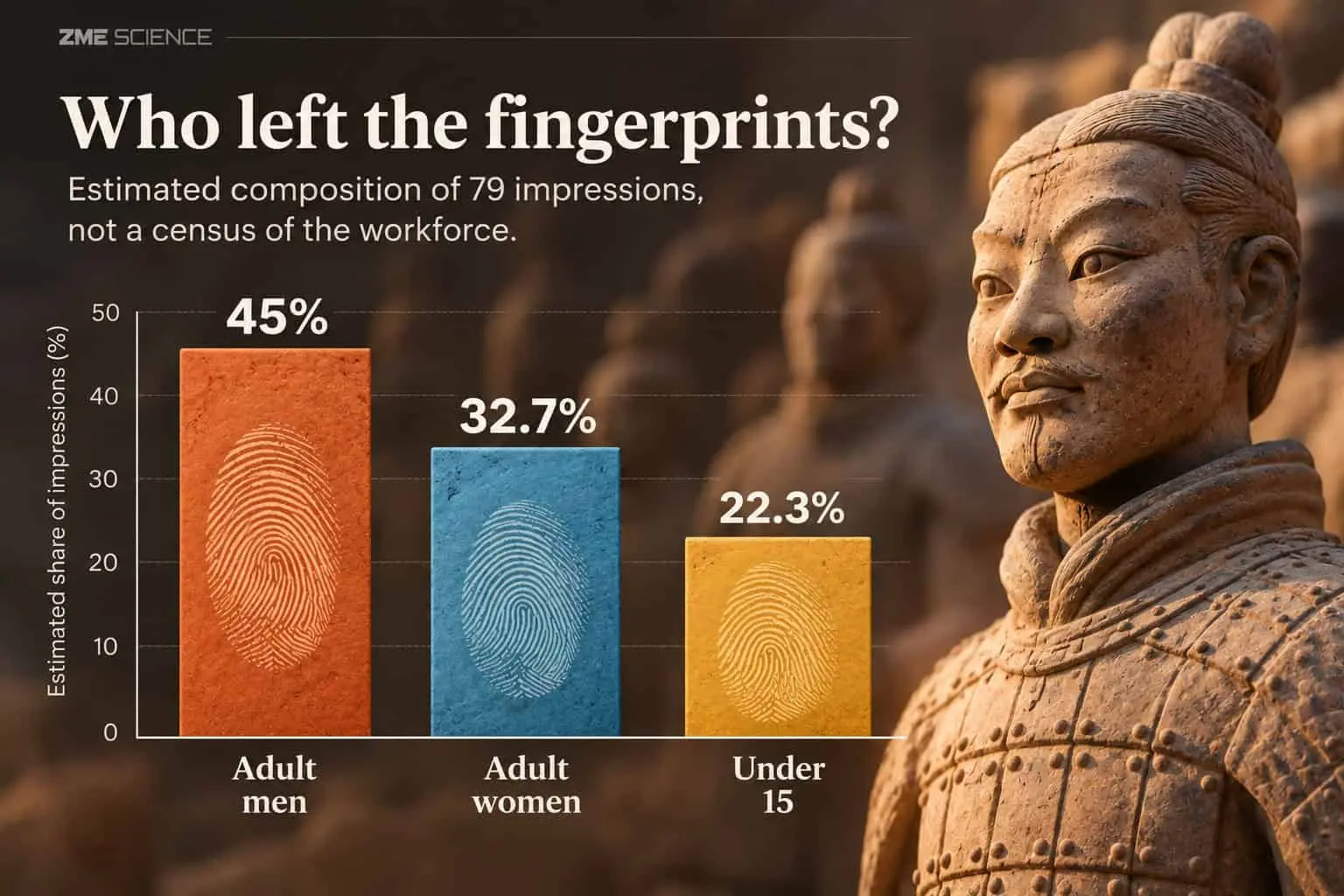
One of the most startling findings is the age of the artisans. By analyzing the size, ridge density, and spacing of the fingerprints, researchers determined that many of the builders were adolescents and young teenagers, some as young as 12 to 15 years old. 👶➡️👦
This aligns with historical records suggesting that Qin Shi Huang’s massive construction projects relied heavily on conscripted labor, including young boys drafted from across the empire.
The small hand sizes and narrow ridge patterns found on many figures strongly indicate juvenile workers, reshaping our understanding of the workforce. 📉
2. 👷 A Highly Organized Workshop System
The fingerprint analysis revealed that the Terracotta Army was not the product of a single master sculptor but was manufactured in a decentralized workshop system 🏭:
- 🔹 Different workshops were responsible for different body parts (heads, torsos, arms, legs)
- 🔹 Assembly teams pieced the parts together
- 🔹 Individual artisans left repeated fingerprint signatures across multiple figures, allowing researchers to track specific workers
- 🔹 At least 87 distinct workshop marks (stamped inscriptions) have been identified on the figures
This suggests a proto-industrial production line — remarkably sophisticated for the 3rd century BCE. ⚙️
3. 🌍 Diverse Origins of the Workers
Chemical analysis of the clay, combined with fingerprint distribution patterns, indicates that workers were drawn from multiple regions across the Qin Empire 🗺️. This supports historical texts describing the forced relocation of hundreds of thousands of laborers to the capital, Xianyang.
4. ✋ Skilled Artisans Among the Laborers
Not all fingerprints belonged to young conscripts. Some prints show larger, more mature hands with evidence of repetitive craft-related wear patterns, suggesting master craftsmen who supervised or performed the detailed sculpting work — particularly the intricate facial features and armor detailing. 🎨
These skilled artisans likely trained the younger workers, creating a master-apprentice hierarchy within the workshops. 🧑🏫➡️👦
5. 🔁 Individual “Signatures” in Clay
Perhaps the most humanizing discovery is that researchers could track individual workers across multiple figures. One set of fingerprints appeared on the torso of a kneeling archer, the arm of a standing infantryman, and the base of a cavalry horse — revealing that a single person worked on different types of figures over time. 🏹🗡️🐎
“You can almost see this person moving through the workshop day after day, pressing their thumb into wet clay, never knowing that 2,200 years later, someone would find their print and say, ‘You were here.'” 🥹
⚔️ The Human Cost Behind the Glory
The fingerprint evidence adds a deeply personal dimension to what was already known about the brutal conditions of Qin Shi Huang’s construction projects:
- 🩸 Workers labored under harsh conscription laws; failure to meet quotas could mean punishment or death
- 🌧️ Many worked in extreme conditions with minimal food and rest
- ⛓️ Historical records (particularly those of Sima Qian, the Han Dynasty historian) describe the project as consuming the lives of hundreds of thousands
- 💀 Mass graves of workers have been found near the mausoleum site
The small, young fingerprints serve as a haunting reminder that behind the grandeur of an emperor’s afterlife lay the exploited hands of children. 😔
🧪 Broader Scientific Impact
The fingerprint research on the Terracotta Army has implications beyond archaeology:
- 🏛️ Forensic Archaeology: Proves that biometric analysis can be applied to ancient artifacts, opening new avenues for identifying ancient workers worldwide
- 🧬 Bioarchaeology: Offers insights into the health, nutrition, and demographics of Qin Dynasty populations
- 🏗️ Ancient Manufacturing Studies: Reveals sophisticated production techniques centuries before the Industrial Revolution
- 🌐 Cultural Heritage: Gives a voice and identity to the anonymous laborers who built one of the world’s greatest wonders
🌟 Why This Matters Today
For over two millennia, the Terracotta Army was celebrated as the vision of one man — Emperor Qin Shi Huang. The fingerprints tell a different story: one of thousands of hands, many of them young, many of them unwilling, all pressing their identity into wet clay under the weight of empire. 👐
The discovery transforms the Terracotta Army from a monument to power into a monument to people. 🕯️
“Every fingerprint is a name we never knew. Every ridge is a life we can never fully recover. But at least now, we know they were there.” ✨
📌 Quick Facts Recap
| 🔑 Fact | Detail |
|---|---|
| 🗿 Discovery Year | 1974 |
| 📍 Location | Lintong, Xi’an, Shaanxi Province, China |
| 👑 Emperor | Qin Shi Huang (r. 221–210 BCE) |
| 🖐️ Fingerprint Analysis | Ongoing since early 2000s |
| 🧒 Youngest Workers Identified | ~12–15 years old |
| 🏭 Workshops Identified | 87+ |
| 🌍 UNESCO World Heritage Status | Granted in 1987 |
🔮 What’s Next?
Research continues at the mausoleum site. Future goals include:
- 🧬 DNA extraction from clay residues to identify genetic origins of workers
- 🤖 Machine learning models to match fingerprints across thousands of fragments
- 🗺️ Mapping workshop locations based on clay composition and fingerprint clusters
- 📖 Cross-referencing with Qin Dynasty administrative records to potentially identify named individuals
The story of the Terracotta Army is far from finished. With every fingerprint analyzed, another chapter is written. 📖✨
🏛️ The Terracotta Army remains one of the greatest archaeological treasures on Earth — but its true legacy may not be the emperor it was built to serve, but the invisible hands that shaped it, one fingerprint at a time. 🖐️❤️
